A childhood of Kashmiri cousins: wedding feasts, stolen pickle, fierce rivalries, and the discovery, long after exile, that the bond outlived the house, the valley, and every ordinary afternoon.
By Sheetal Raina
The summer of 1985, or maybe 1986. The years have softened at the edges, and I can no longer swear to which. There had been a wedding at the Razdan house, which meant Bhaiya and I had eaten our way through course after course of wazwan until we could swallow no more, washing it down with as much Campa Cola as two small bodies could be persuaded to hold. When it was time to go home, the grown-ups, in their wisdom, decided we should go separately. Bhaiya, my older cousin, was allowed to ride his bicycle the long miles from Shivpora to Habba Kadal. I was to take the Matador, the rattling shared van that served as our bus but is, in truth, more a feeling than a vehicle, with a ten-rupee note folded into my fist for the fare. His one instruction was to see me onto the right van.
We were children, and children draw the shortest line between two points. Why wait for the matador at all, he reasoned, when he could carry me home on the back of his cycle. So that is what we did. We wobbled the whole way from Shivpora to Habba Kadal and arrived without so much as a scraped knee, the ten rupees still warm in my hand.
This left us with a problem and an opportunity. If we said nothing, the money was ours. We said nothing. We spent most of it on gol gappas, standing at the cart until our eyes streamed. The secret held a few days. Then one of us, I honestly cannot remember which, cracked under the weight of it and confessed the whole enterprise. It was dangerous. It was thoroughly irresponsible. The grown-ups were appalled. I have carried it, gleaming, for nearly forty years, and I would not hand it back for anything in the world.
That is what a cousin was, in the years before everything changed. The accomplice.
Rich in each other
There were a great many of us. We did not all live under one roof, or even in the same town, but childhood kept folding us back into the same thaal anyway: the summer holidays, the long shut-in winters, every wedding and festival that gave the grown-ups a reason to gather and us, each other.
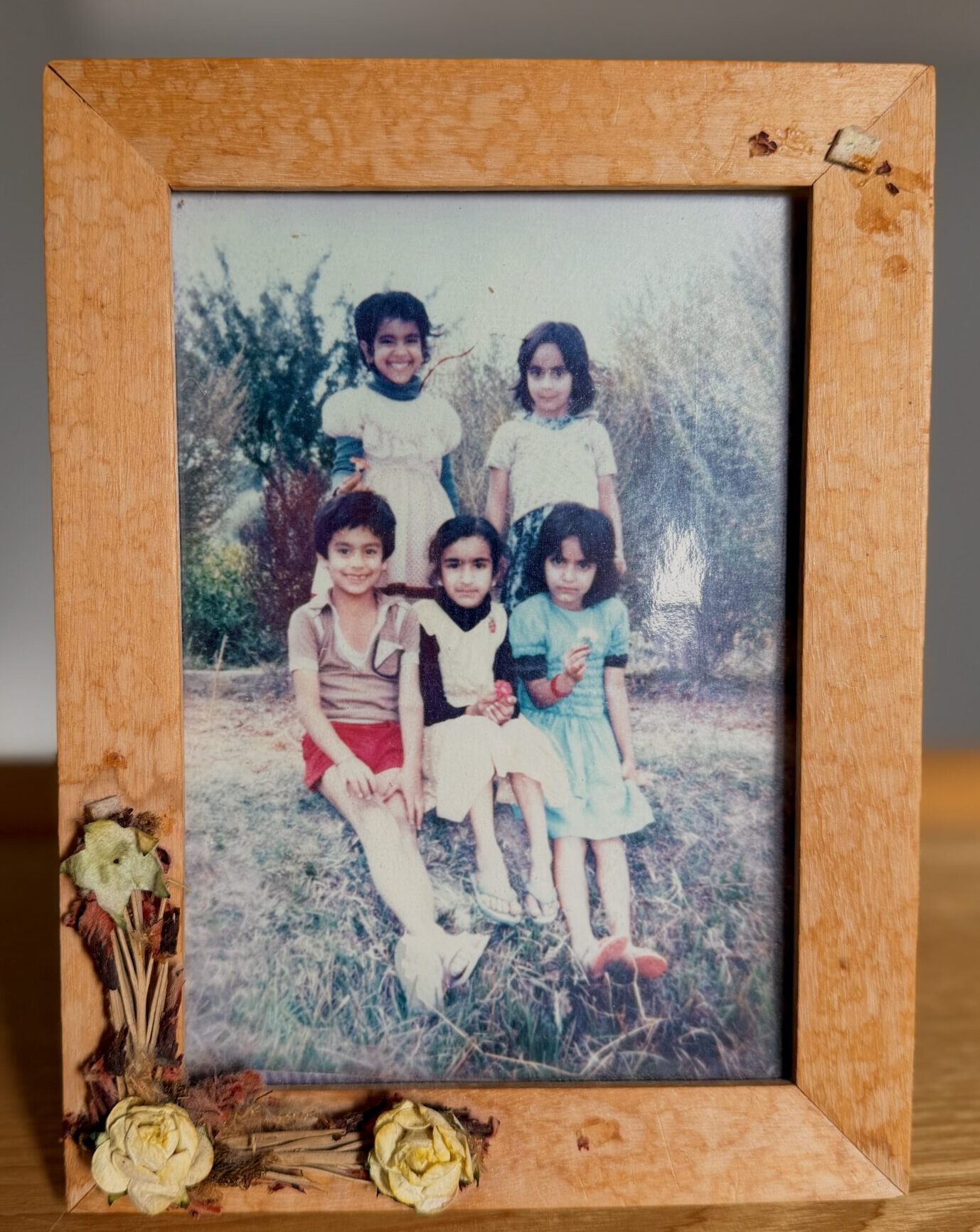
One photograph survives from those years, borrowed from an aunt long afterwards, because so little of our own came away with us. My sister, our cousins, a wedding, soft autumn light and hay stacked behind us. I am in the middle, in yellow, daydreaming about something. I have no idea what. Nobody is performing for the camera. We are simply together, and unaware. I take it out more often than I would admit to anyone, and what I feel is not quite sadness. It is the ache of understanding, too late, that the ordinary afternoon inside that frame was already running out, and not one of us in it knew.
We were rich in each other and in almost nothing else a child thinks to count. We cracked walnuts against the hinge of the door, and the mulberry trees stained our mouths and hands so deeply that no amount of scrubbing would lift the green for days.
We were rich in each other and in almost nothing else a child thinks to count.
Enemies before lunch
And we fought. Nobody warns you about that part. Tantrums and shoving, doors slammed hard enough to rattle the windowpanes, solemn vows never to speak again that rarely outlived the afternoon. But the rivalry I remember most tenderly was quieter than any of it, and it had a name. Let's call it Y.
Y and I were one of those pairs who could not live with each other and could not live without each other, and she knew, better than anyone alive, exactly how to wind me up. The summer she came to stay, she let slip that she had been promised a new popular toy if she did well in her exams. Nobody had promised me any such thing. It did not matter in the least. When my own results came out, I staged a tantrum of such operatic proportions that my grandfather, purely to make it stop, went out and bought me one of my own, and I spent several glorious days insufferably pleased with myself. Then the truth surfaced. There was no toy coming for Y. There had very likely never been a promise at all. She had dangled the whole thing in front of me to see whether I would bite, and I had swallowed it whole. Hook, line, and tantrum. She had played me to perfection. I was the one who ended up with the toy. To this day I could not tell you which of us won.
That was Y and me all over, and in one form or another it was the rhythm of all of us. Enemies before lunch, thick as thieves by the time the lamps were lit, and not one of us keeping score in the morning. You needle the people you are surest of, the ones you cannot imagine ever having to do without. We went at one another so freely because losing each other had never once crossed our minds. It had not occurred to us that anyone could be taken away. It had not occurred to us that anything could.
Written in pickle and in silence
And thick as thieves was no figure of speech. In winter, when the cousins came to stay, the mattresses came out across the floor of the main room and we slept in one long row of quilts with the Bukhari ticking and glowing in the corner. My grandmother slept in that same room, in her own bed against the wall, and it was under that bed that she kept her treasure. She was famous for her aachar. All summer she tended them, kohlrabi cut into chunks and turned through her own ground spices and sealed into terracotta jars, the lids closed under a layer of clay. She swore, with total confidence, that she would know the very instant any one of them was opened.
She was not wrong, in the end. She was only slow. For several nights running, once the house had gone quiet, one of the older cousins would post me under the bed, because I was the smallest and the only one who fit, and I would ease a knife beneath the clay seal, lift out a few cold slices, and pass them up into the dark to be shared down the whole row of quilts. Then we pressed the seal back as best we could and squeezed ourselves under the covers again, breathless, pickle on our fingers, certain we had carried off the perfect crime. We got away with it the better part of a week. We were undone in the end not by my grandmother's legendary nose but by an ordinary lunch, the afternoon my aunt came to visit and my grandmother reached under the bed for a jar to set before her daughter and found a whole summer's work half gone.
We were found out. Not one of us said a word.
That was the contract, written in pickle and in silence. We would gladly betray one another over a hand of cards. We would not give each other up to save our own skins, not to the sternest grandmother, not over any crime, not for anything in the world. We were allowed to be cruel to each other. No one else alive was.
We were allowed to be cruel to each other. No one else alive was.
And then we left.
I will not make this the story of why. It is enough to say that after we moved out of Kashmir, into the plains of Jammu and beyond, the house and the orchard and the whole order of that life were gone to us. Nobody tells you which time is the last time. There was a last night under those quilts, the Bukhari going down to embers, someone's cold feet pressed against mine. There was a last raid on the pickle jars. Then the door shut.
The cousins scattered. We grew up elsewhere, under different skies, in accents our grandmothers would not have recognised. The gatherings that had once been the very furniture of our childhood thinned, and then mostly stopped. We learned to love each other across distance and time zones, in snatched phone calls and the long silences between them, each of us carrying the valley folded up like the ten rupee note in my sweaty palms.
So I told myself that part of my life had stayed behind. Sealed up in one house, in one decade, in a city I no longer visited. Mine to take out and turn over and grieve, the way I turn over that photograph. I thought I had grown out of it the way you grow out of a coat.
It arrived in my daughter
Then I watched it arrive, whole and unannounced, in my daughter.
She was reading an obituary for an uncle she had loved dearly. She held the sheet of paper in both hands, and as she began, her hands shook so hard the words would not hold still. She got through the first line. Her voice gave out in the second. I started to rise.
Her cousin moved first. He had lost the same uncle, was carrying the same grief, and was barely more than a child himself. He stepped behind her and put his arms over her shoulders. He was crying too. He wiped her face with one hand, then his own, and kept on until she found her voice again.
She read the rest of it with him behind her.
I had to look at the floor. I could not watch it and breathe at the same time.
And there it was. Everything I had felt my whole childhood and had never once had words for, standing in front of me in two children I had taught none of it. I was watching Bhaiya steady me on the back of a cycle. I was watching the long row of us close ranks over a half-empty jar. I was watching Y refuse, to the very end, to tell me whether she had won. The fighting and the fierce, unreasoning loyalty had never been two things. They were one thing the whole time, wearing different faces on different days.
My own generation is greying now. The grandparents are gone. The house we crowded into those winters belongs to strangers, in a home that will always belong to me. The cousins I once swore lifelong war on are across cities and time zones, have children of their own and we go months, sometimes years, without sitting in the same room. But I know one thing. If I called any of them tonight and said I needed them, they would put down whatever they were holding and be with me.
No one decided to hand this to my daughter. It came down to her the way the colour of her eyes did. We lost the house, the town, every ordinary afternoon we were too busy living to count. But I watched one grieving child comfort another with the same hand, and there it was again, whole.
We were each other's first friends.
We would always show up and no boundaries would exist.
Dr. Sheetal Raina is the founder and editor of ISBUND, an immersive platform dedicated to preserving and celebrating Kashmiri culture. Deeply connected to the heritage and traditions of Kashmir, she brings a distinctive voice to cultural discourse - blending academic insight with heartfelt commitment to her roots.
Thank you again, I get to see layers of the life in Kashmir with every article.The accomplices were surely the last generation who left as children from Kashmir, and have those tender memories.
Wow… this is beautifully written. It makes me feel that those of us born after migration inherited the stories, but missed living the memories ourselves. I wish we had the chance to make and cherish moments like these.
We value your privacy. To improve your experience, we use cookies and similar technologies for the following purposes:
- Essential functions: These cookies make the site work properly and keep it secure.
- Analytics: These cookies help us understand how the site is used and improve performance.
- Personalisation and marketing: These cookies show relevant content and measure engagement.
You can choose which categories to allow. Your preferences will be saved for future visits, and you can change them at any time in Cookie Settings.
This website uses cookies
Websites store cookies to enhance functionality and personalise your experience. You can manage your preferences, but blocking some cookies may impact site performance and services.
Essential cookies enable basic functions and are necessary for the proper function of the website.
Name
Description
Duration
Cookie Preferences
This cookie is used to store the user's cookie consent preferences.
30 days
You can find more information in our Cookie Policy and .








Shanoo Razdan
Superb excellent. Touched by each word,felt like part of the story.