-By Sheetal Raina & Moksha Laxmi
The MV Hondius had been at sea for five days when the first passenger fell ill. A 70-year-old Dutch gentleman, who had spent several weeks travelling through Argentina before boarding at Ushuaia on 1st April 2026. His symptoms, fever, headache and mild diarrhoea, were not immediately alarming. Then came the breathlessness. He sadly passed away on 11th April, somewhere between South Georgia and Saint Helena, in the middle of the South Atlantic.
The ship sailed on. His body was removed at Saint Helena thirteen days later. His wife, who had shared the cabin with him, developed the same symptoms that same day and was evacuated to Johannesburg by air, where she died on 25th April. A third passenger died on 2nd May. By the time laboratory tests in South Africa confirmed hantavirus on 2nd May, the ship had been carrying the infection for nearly a month, and 23 passengers had already disembarked at Saint Helena without knowing what was aboard.
The WHO called it “serious but contained”. Both things were true.
What makes outbreaks frightening is not only how dangerous they are, but how ordinary they begin. A headache after a long journey. Fever mistaken for exhaustion. Someone deciding to rest in their cabin instead of joining dinner. Most outbreaks do not arrive looking dramatic at first.
For the passengers who survived, the question was straightforward: how did this happen?
For epidemiologists, a different question pressed harder: why don’t more people know what hantavirus is?
The Pathogen You Haven’t Met Yet
The answer begins, as it often does with zoonotic diseases, in an animal reservoir that has been carrying the infection quietly for millions of years.
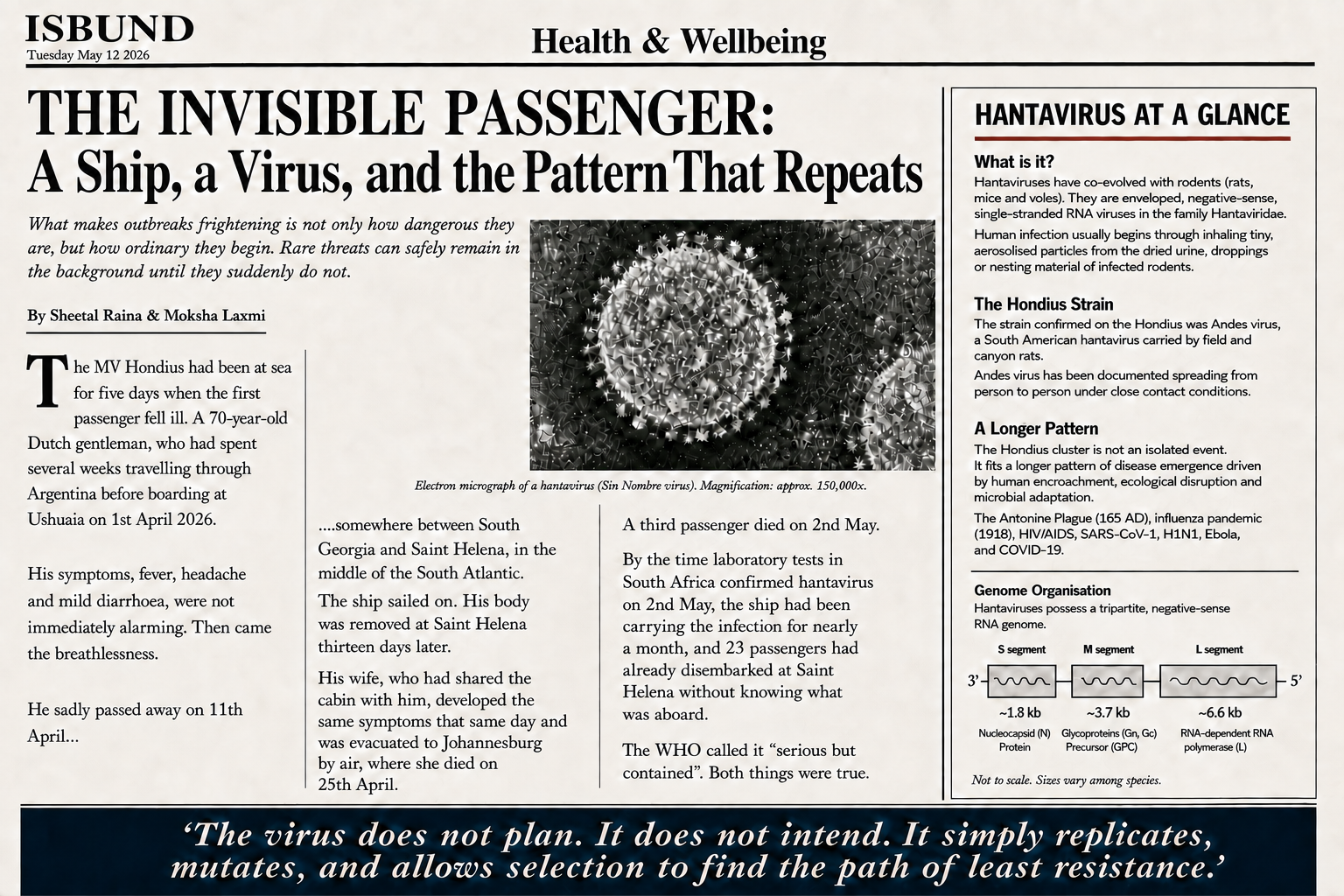
Hantaviruses have co-evolved with rodents (rats, mice and voles), so successfully that infected animals carry the virus for life with no obvious illness. Human infection usually begins through inhaling tiny, aerosolised particles from the dried urine, droppings or nesting material of infected rodents. Direct contact is not always necessary. Cleaning an old shed, disturbing storage areas, hiking through contaminated terrain or even sweeping dust in enclosed spaces can sometimes be enough.
The WHO’s initial assessment of the Hondius outbreak identified shore excursions around Ushuaia as the most likely exposure point.
The incubation period ranges from one to eight weeks, which is part of what makes hantavirus difficult to trace. By the time symptoms appear, the original exposure may have happened weeks earlier and in an entirely different location. A patient may already be hundreds or thousands of miles away from where the infection occurred.
The clinical picture varies by geography.
In Europe and Asia, so-called Old-World hantaviruses primarily affect the kidneys, causing haemorrhagic fever with renal syndrome. Some strains, such as Puumala virus circulating in Scandinavia, are relatively mild and many patients recover fully. Others, including Hantaan virus found in parts of East Asia, are far more severe.
In the Americas, New-World hantaviruses mainly attack the lungs, leading to Hantavirus Pulmonary Syndrome (HPS). Early symptoms resemble influenza: fever, fatigue, muscle aches and headache. But in severe cases, patients can deteriorate rapidly as fluid accumulates in the lungs, making breathing progressively more difficult. A CDC analysis of US cases between 1993 and 2009 reported a case fatality rate of approximately 35 percent.
There are currently no licensed vaccines and no universally effective antiviral treatment. In severe cases, survival often depends on rapid intensive care support, including extracorporeal membrane oxygenation (ECMO), which temporarily performs the work of the lungs and heart. Such technology exists in advanced hospitals, but not on a ship, days away from the nearest major port.
The strain confirmed on the Hondius was Andes virus, which complicates the usual understanding of hantavirus transmission in one important way. Unlike most hantaviruses, Andes virus has been documented spreading from person to person under close contact conditions. This remains uncommon, but it is scientifically recognised. One outbreak in Argentina produced 34 infections from a single introduction.
Even limited person-to-person transmission changes the public health response. It means the virus is no longer confined only to rodent exposure, making contact tracing and monitoring substantially more important.
What a Virus Actually Is
Part of the difficulty in controlling RNA viruses lies in what they fundamentally are. A virus is remarkably simple: genetic material wrapped in protein, unable to reproduce without entering a living cell. But many RNA viruses possess one important characteristic, they copy themselves quickly and imperfectly.
Human cells contain sophisticated systems that detect and repair mistakes during genetic replication. Many RNA viruses lack that level of proofreading. As a result, copying errors accumulate constantly. Most of these mutations are useless or harmful to the virus itself. But occasionally, one provides an advantage: better survival inside the host, improved attachment to cells or more efficient transmission.
Evolution does not plan ahead, but given enough replication, chance can begin to resemble strategy.
During peak infection in a single patient, there may be trillions of viral particles, each slightly different from the others. Virologists describe this not as a single uniform entity, but as a quasispecies, a swarm of related variants clustered around one dominant form.
The problem is not only the virus scientists already recognise. It is the countless minor variants quietly emerging during replication, most of which disappear, while a few occasionally gain characteristics that alter how the disease behaves.
This is one reason RNA viruses can adapt so effectively to changing environments and new hosts.
A Longer Pattern
The Hondius cluster is not an isolated event. It belongs to a much older and recurring pattern. The Antonine Plague of 165 AD, likely smallpox, is estimated to have killed millions across the Roman Empire. The influenza pandemic of 1918 infected roughly one-third of the world’s population and killed between 50 and 100 million people. More recently:•
HIV/AIDS, First recognised in medical literature in 1981, though human infections likely began decades earlier. More than 40 million deaths worldwide.
SARS-CoV-1 (2002–2003), Contained relatively quickly, but demonstrated the pandemic potential of coronaviruses.
H1N1 influenza (2009), Less deadly than initially feared, but exposed weaknesses in vaccine manufacturing and distribution systems.
Ebola (2013–2016), Nearly 30,000 cases and over 11,000 deaths in West Africa, overwhelming fragile healthcare systems despite limited airborne spread.
COVID-19, More than seven million confirmed deaths globally, with excess mortality estimates suggesting the true number is considerably higher.
Most people experience pandemics as interruptions to normal life. Epidemiologists often see them differently: not as rare accidents, but as recurring biological events shaped by ecology, global travel, urbanisation and human behaviour.
The lesson that repeatedly fades from institutional memory is relatively simple. Systems built urgently during one outbreak are often neglected once the immediate danger passes, only to be rebuilt during the next crisis.
The Ship as a Case Study
What makes the Hondius outbreak important beyond the immediate tragedy is its timeline and mechanism.
The vessel departed Ushuaia on 1st April carrying 147 passengers and crew. Illness onset among confirmed cases stretched from 6th to 28th April, long enough that no single exposure point was initially obvious.
Twenty-three passengers disembarked at Saint Helena on 24th April before hantavirus had been identified. At that stage, there was no clear reason to detain them. They returned to the Netherlands, the UK and elsewhere.
Most were probably thinking about unpacking luggage, recovering from travel fatigue or sharing photographs from the voyage, not anticipating contact tracing calls from public health authorities weeks later.
The Diamond Princess quarantine off Yokohama in 2020 demonstrated how efficiently respiratory pathogens can spread aboard ships through close proximity and shared indoor systems. The Hondius outbreak involved a different transmission pathway, but highlighted another vulnerability: what passengers encounter during shore excursions.
Biosecurity is often discussed in terms of preventing dangerous material from boarding a vessel. The Hondius case is a reminder that exposure can also occur during tourism activities in regions where certain pathogens naturally circulate. That possibility rarely appears prominently in pre-travel briefings.
What Comes Next
Pandemic preparedness experts have long regarded highly pathogenic H5N1 avian influenza as one of the most concerning future threats, particularly if efficient human-to-human transmission develops. Public health agencies have warned about this possibility for years, and the concern is scientifically justified.
The difficulty is that the next major pandemic may not emerge from the pathogen receiving the most attention.
SARS-CoV-2 came from a viral family already recognised as dangerous, yet the scale and speed of the pandemic still exceeded most expectations.
At the same time, scientific tools are advancing rapidly.
Metagenomic sequencing can now identify unfamiliar pathogens within hours of obtaining clinical samples. mRNA vaccine platforms allow candidate vaccines to be designed within days after sequencing a viral genome. Researchers are also developing broad-spectrum antivirals that work by increasing viral mutation rates beyond survivable limits, effectively turning the virus’s own unstable replication process against itself.
The science is improving faster than many public health systems.
Whether those systems remain funded and prepared between emergencies is ultimately a political question rather than a scientific one. At present, the answer is not entirely reassuring.
The Pattern That Repeats
The passengers aboard the Hondius were not reckless people ignoring obvious risks. Hantavirus exposure during wildlife tourism in Patagonia is not part of standard travel advice, and the couple who died had done nothing unusual by ordinary travel standards.
What the Hondius case demonstrates, as COVID-19 did, as Ebola did and as many outbreaks before them have done, is that the most dangerous risks are often invisible until after exposure has already happened.
That is not an argument for fear or fatalism. It is an argument for sustained surveillance, scientific investment, stronger health systems and public education that continues even when no immediate crisis dominates headlines.
Three people died on a ship in the South Atlantic. The virus responsible has been known to science for decades. The problem was never complete ignorance. It was the assumption that rare threats can safely remain in the background until they suddenly do not.
Public health systems are often judged by visible failures, but their greatest successes are usually the crises that never fully emerge. Prevention is quiet, which is precisely why it becomes easy to undervalue, right until the moment it is no longer enough.





Sudha koul
An important reminder that science and public health can never be taken lightly. Brilliantly researched and very engaging from start to finish.