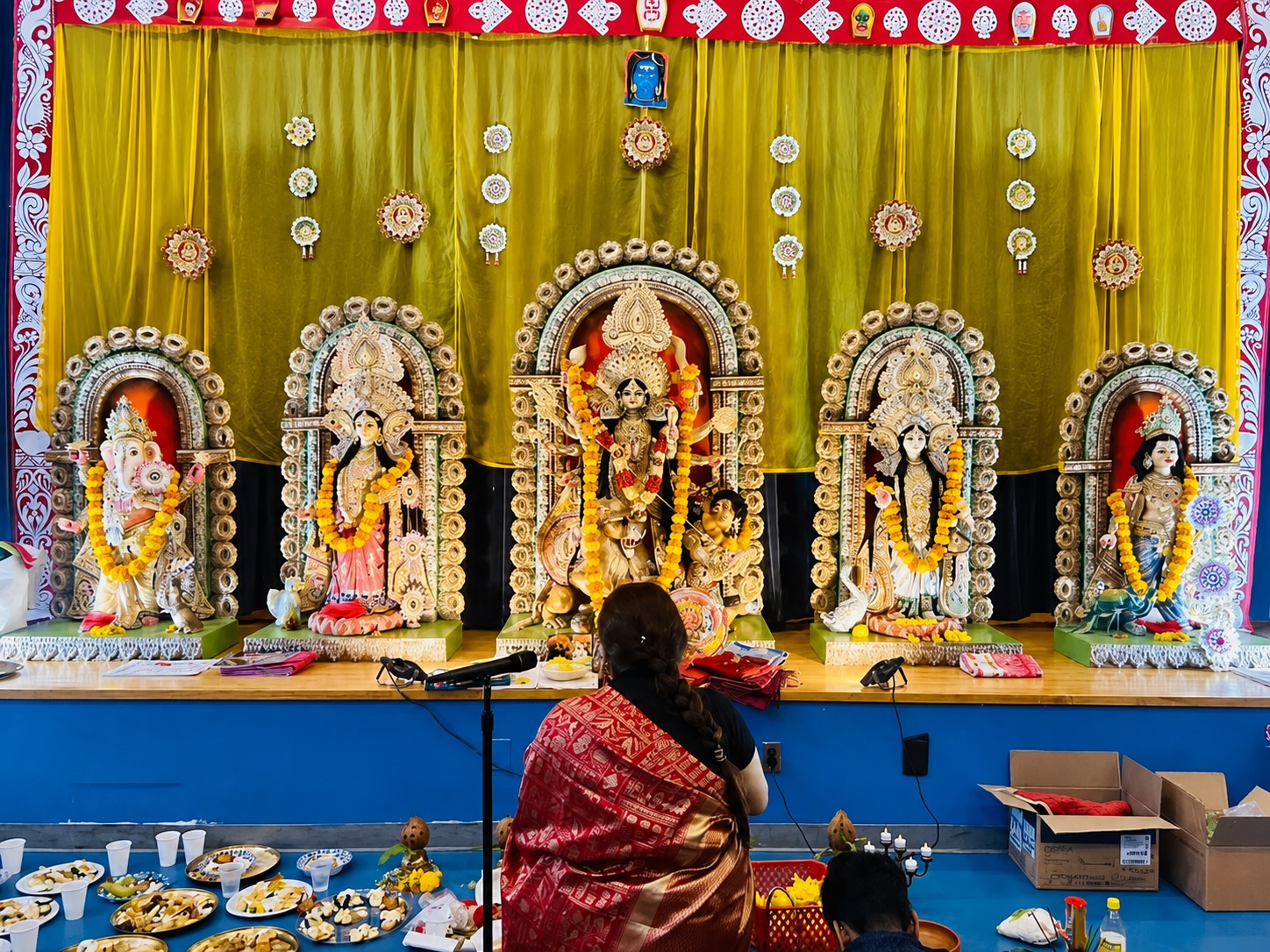
The panchamukha pradeep is already burning when I take my place before Maa Durga as I start the Debi-Baran on Maha-Shashthi. The smoke rises in the way smoke always has, indifferent to who is holding the vessel, indifferent to gender, indifferent to the categories that human institutions have spent centuries building and defending. Around me are hundreds of familiar faces in a hall in Philadelphia, people who crossed an ocean and built something extraordinary far from home: Sharanya, a Durga Puja in the heart of Philadelphia, founded by scholars and scientists who carried the Mother in their hearts through dissertation defenses and grant applications and the particular loneliness of being very far from where you grew up. They built Her a home here. And then, in a decision that was the community's alone to make, an act of collective trust I did not seek and cannot fully account for, they asked a woman to perform the Puja.
The fortune was mine. I stand at the altar not as a statement but as a consequence: of a tradition deeper and more capacious than its narrowest interpreters, and of a lineage of women and men whose names I carry into the room whether I invoke them aloud or not.
The ancient permission
The education that prepared me for this moment is two-fold and inseparable. In one register, it is the education of a life scientist: the training that teaches you to read carefully, to question received wisdom, to follow evidence past the point of comfort. In another, it is the education of someone who grew up well-versed in knowledge of the scripture, in a family of priests that ran a Sanskrit gurukul through centuries in a quaint village in Birbhum, India. Inside the Chandipath lies a tradition that rewards those who study it rigorously with something the laboratory alone cannot give: a grammar for the sacred. What I did not fully understand until I began to look seriously is how far back that second education goes, and how many women were part of it long before I was.
Before there were temples with garbha-griha (sanctum sanctorum) doors locked for women, there was a court in Videha where a woman rose and challenged a god-like sage on the deepest questions of existence. Gargi Vachaknavi, a Brahmavadini, stood before Yajnavalkya and pressed him, twice, to account for the nature of ultimate reality (Brihadaranyaka Upanishad). She was not an exception ceremoniously noted and set aside, but a formally recognized category of scholar. Her contemporary Maitreyi, when offered her husband's wealth before his departure for renunciation, refused it with a philosopher's precision: what use is wealth if it cannot grant immortality? She chose knowledge. The Vedic world had a word, Brahmavadini, for women who discoursed on Brahman, pursued spiritual knowledge as a vocation and underwent Upanayan, the sacred thread ceremony that initiated a life of learning. The Rig Veda preserves hymns composed by approximately twenty-seven female seers, Rishikas, each a Mantra-drashtri—one to whom divine knowledge was revealed. Their mantras carried the same sacred authority as any man's. What came later, the narrowing encoded in texts like the Manusmriti, was not tradition. It was departure from it.
The bhakti door
When formal Vedic avenues contracted around women, bhakti, or devotional love, became the corridor through which women entered the sacred on their own terms, armed with nothing but the depth of their knowledge and the force of their devotion. Andal, the ninth-century Tamil poet-saint, composed the Thiruppavai with a scholar's precision and a lover's abandon. It is recited in Vaishnava temples every morning to this day; a woman's voice is built into the daily liturgy of an entire tradition. Lal Ded wandered fourteenth-century Kashmir composing Vakhs that became the foundation of a literary tradition revered by Hindus and Muslims alike. Akka Mahadevi debated male saints in the Anubhava Mantapa, the world's first recorded philosophical parliament, on questions of the self and the Absolute. It fostered radical inclusivity, allowing people of all castes, classes and genders to debate philosophy, morality and social justice. Mirabai made her devotion to Krishna so total and so rigorously lived that it constituted sustained intellectual and spiritual defiance against every expectation placed upon her. Janabai found the divine present in the grinding of grain and composed Abhangs that are sung alongside those of the greatest male saints of Maharashtra.
These women did not petition for access. They built their authority from the inside out, through study, through practice, through a mastery of the tradition so complete that it could not be taken from them.
What unites them is not gender but a quality of learning so rigorous, and devotion so whole, that the institutions of their time could neither absorb nor dismiss them.
Across civilizations the same figure appears: Enheduanna of Babylon, the first named author in human history, composing philosophically sophisticated hymns to Inanna, the ancient Sumerian “Queen of Heaven”. The Pythia at Delphi, always a woman, whose pronouncements shaped the politics of the ancient Mediterranean world. Rabia al-Adawiyya of Basra, whose theology of pure love of the divine for its own sake, without calculation of reward or punishment, became a cornerstone of Sufi thought. What unites them is not gender but a quality of learning so rigorous and devotion so whole that the institutions of their time could not absorb or dismiss them.
Bengal's inheritance
Bengal produced its own version of this current, and it ran through both scholarship and spiritual life simultaneously, which is perhaps why it feels so native to me. The nineteenth-century renaissance in Calcutta/Kolkata understood that the liberation of the nation and the education of its women were not parallel projects but the same one. Raja Ram Mohan Roy dismantled Sati with the force of moral and textual argument: he went to the scriptures and showed that the practice had no basis there. Ishwar Chandra Vidyasagar fought for girls' education and widows' rights with the same instrument: evidence, reason and an insistence that tradition, properly understood, supported rather than opposed reform. Rani Rashmoni built the Dakshineswar Kali temple with her own wealth and on her own terms, demonstrating that female patronage and authority had always built the rooms where so much else became possible. Kadambini Ganguly became a practicing physician when society ridiculed her. Sarala Devi Chaudhurani founded India's first nationally organized women's association. Begum Rokeya Sakhawat Hossain imagined a world in which women ran the laboratories and universities—and then built a school.
And then there is Sri Sarada Ma, a village woman from Jayrambati with no formal education by any conventional measure, who became the spiritual axis of a global institution through the quality of her presence and the depth of her understanding. She did not hold a title or argue for her authority. She simply embodied a knowledge so complete that thousands came to receive it. Anandamayi Ma performed her own initiation, recognizing no human gatekeeper between herself and the divine. Sister Nivedita, born Margaret Noble, an Irishwoman who became Hindu by choice and Bengali by devotion, understood the philosophical logic: if the Supreme Principle is feminine, if Adi Shakti is the animating ground of all existence, then the exclusion of women from ritual authority is not orthodoxy. It is incoherence.
What Sharanya, Philadelphia enacts
The formal exclusion of women from priestly roles has no Vedic textual basis. It is convention masquerading as scripture, and it does not survive serious examination. Perhaps that is why a community of scholars, professionally committed to serious examination, did not find it persuasive. Sharanya is, in this sense, doing what it has always done: applying rigor. The same instinct that drives a scientist to question an experimental assumption drives a community to ask whether the tradition they love actually says what they have been told it says. It does not. And so, a woman performs the rites.
What moves me most is not my own role but what the Puja itself embodies: the bhog for the Goddess is prepared by hands of every background, every lineage, every caste, because at Sharanya there is no gatekeeping at the kitchen door, no hierarchy of whose offering is acceptable. The sacred meal is made by all, for all, and offered to the one from whom all equally arise. On Bijaya-Dashami, when the time again comes for the Debi-Baran, the farewell ceremony that returns Maa Durga back to Kailash, men step alongside the women, participating fully in a rite of leave-taking that tradition had sometimes reserved for wives and mothers alone. At Sharanya it belongs to everyone, because the Mother belongs to everyone, because the Creator, from whom every race, every caste, every gender, every exhausted postdoc far from home equally and without exception emerges, admits of no walls. You cannot build a gate around the Infinite.
When the conch sounds and Maa Durga is called down, I am aware of standing in a very long line. Gargi pressing Yajnavalkya past the edge of what language can say. Maitreyi choosing knowledge over comfort. Andal's voice rising every morning in temples across South India. Sarada Ma initiating thousands from a village in Bengal. The Rishikas composing hymns that would outlast every dynasty. And closer, the Bengali women and men in Philadelphia, scientists and doctors and engineers who built something sacred with their own hands and then entrusted its heart to a woman, not as a declaration, but as recognition. A recognition that the tradition had always had room for this, and that this room was not new. It had only been locked for a while, by people who were not the tradition itself.
I was given the privilege of standing at its center and performing Shakti Aradhana, on behalf of a community that knew, before I did, that this was not unusual. It was simply correct, a restoration of something that had always been there, waiting, the way the Shiuli flowers wait all year to bloom for exactly five autumn days and fill the air with what they have been holding in silence.







Sheetal Raina
This essay moved me deeply. Reading about Lal Ded, our Lalla, who wandered Kashmir composing Vakhs that crossed every boundary of caste and creed, sitting alongside Gargi, Maitreyi and Andal felt like a homecoming. What strikes me most is how you show that this is not a modern argument but an ancient truth: that women’s spiritual authority was never an exception, only a river that was dammed for a while. As a Kashmiri, I grew up knowing that Lalla’s words belonged to Hindus and Muslims alike, that the sacred does not recognise the walls we build around it. Sharanya seems to understand the same thing. Thank you for writing this, and for reminding us that restoration is not revolution. It is simply memory. And thank you for bringing this piece to ISBUND. We appreciate it deeply.