


Will AI Take the Vet’s Job
Samara Ogra Menon is a Year 12 student in the UK. This essay received the Bronze Award at the Lincoln Life Sciences Essay competition 2026 run by Oxford College.
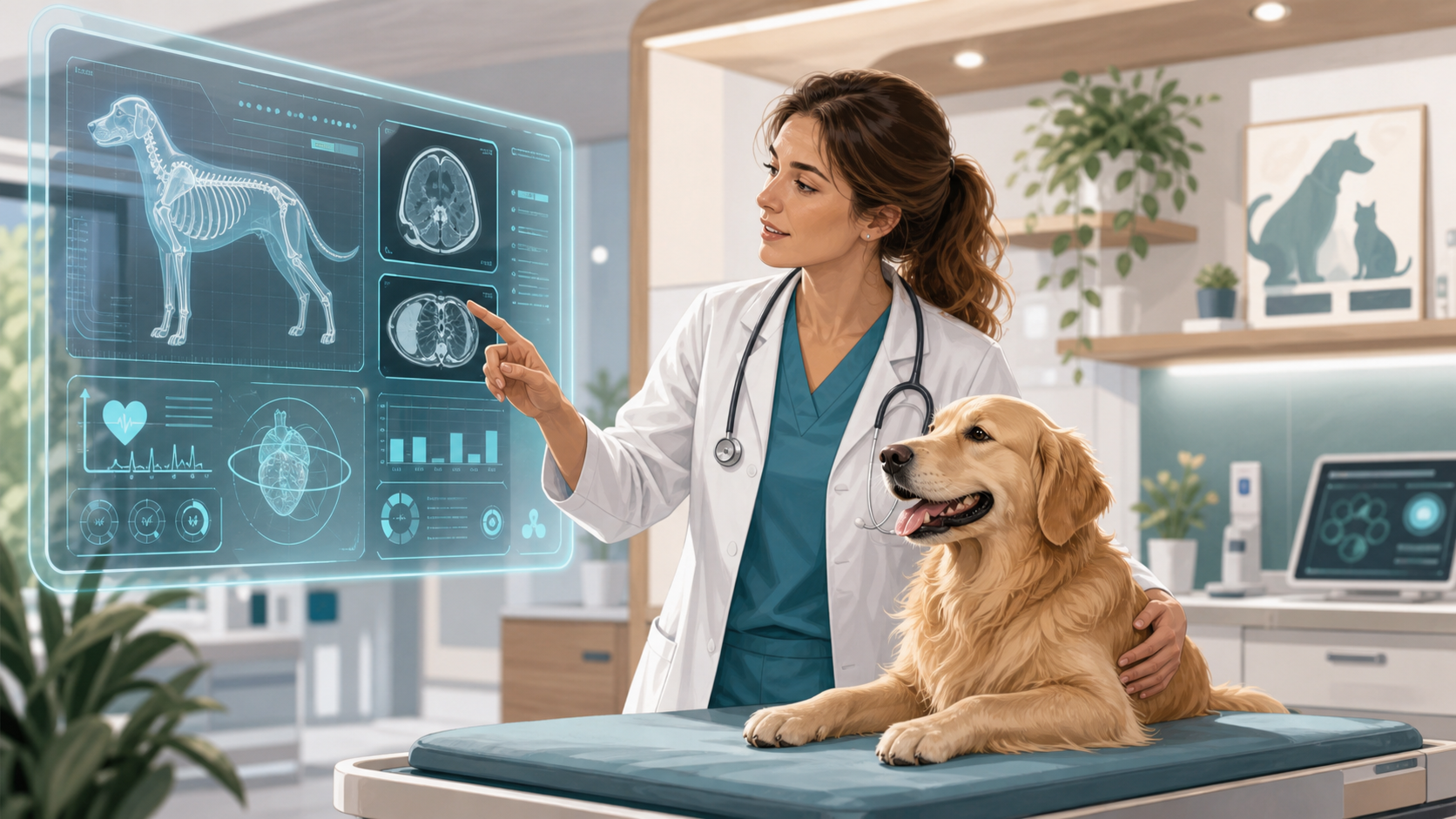
The use of Artificial Intelligence (AI) is becoming increasingly prevalent in all streams of medicine. The rise of AI has sparked many debates about whether it could make doctors and researchers redundant. However, when we consider veterinary medicine, a similar question arises: could AI replace veterinarians? AI is already being used in veterinary practices and by animal researchers for tasks such as analysing radiographs and ultrasounds, tracking animal behaviour, and predicting disease outbreaks in livestock (Marras et al., 2023). These tools are transforming how veterinarians diagnose and manage animal health. However, while AI can enhance certain aspects of veterinary work, it cannot replace the clinical judgement, ethical decision-making, and key communication with pet owners that are central to the profession (Elders et al., 2026; British Veterinary Association, 2026). In veterinary medicine, AI is most powerful when it complements the expertise of a veterinarian rather than replacing it (British Veterinary Association, 2026).
AI offers numerous advantages in veterinary medicine such as excelling at analysing images and at pattern recognition. Researchers at Stanford have developed a deep learning algorithm capable of diagnosing skin cancer, trained on images of skin lesions (Stanford University, 2017; Esteva et al., 2017). The system was trained using a dataset of nearly 130,000 clinical images representing more than 2,000 different skin diseases, allowing the model to learn the visual characteristics associated with malignant and benign lesions (Esteva et al., 2017). During evaluation, the algorithm was tested against 21 board-certified dermatologists and performed at a diagnostic level similar to trained dermatology specialists when identifying conditions such as melanoma and keratinocyte carcinoma (Esteva et al., 2017). The model achieved high diagnostic accuracy across several tasks, including the classification of melanoma from dermoscopic images. Its performance, measured using the area under the receiver operating characteristic curve (AUC), exceeded 91%, indicating a strong ability to distinguish between cancerous and non-cancerous lesions (Esteva et al., 2017).
Similar approaches are emerging in veterinary medicine. Researchers at the Royal (Dick) School of Veterinary Studies developed a deep learning model to detect middle ear disease in dogs using CT scans (University of Edinburgh, 2025). The system was trained on around 500 annotated CT images of canine middle ears, which had been labelled by veterinary specialists to indicate healthy or diseased tissue (University of Edinburgh, 2025). Despite the relatively small dataset, the model achieved approximately 85% diagnostic accuracy in identifying ear disease (University of Edinburgh, 2025). This demonstrates how AI could support veterinarians in interpreting CT scans and other diagnostic images that produce large amounts of information requiring careful analysis by rapidly screening images and highlighting potential abnormalities. This could improve efficiency in veterinary practice and allow clinicians to focus more on clinical decision-making and patient care.
AI is also increasingly being used to analyse large datasets of animal images and behavioural patterns, allowing researchers to monitor wildlife and detect changes in animal populations far more efficiently than manual methods. Organisations such as the World Wide Fund for Nature (WWF) are using thousands of motion-triggered camera traps to monitor wildlife populations (WWF for Nature, 2025). These cameras capture millions of images each year, which would traditionally require months of manual sorting and analysis by researchers but can instead be rapidly analysed and categorised using AI (WWF for Nature, 2025).
Using this knowledge, the WWF developed the Wildlife Insights platform, which uses an AI model to automatically identify animals within certain images (WWF for Nature, 2025). The model has been trained on over 65 million images which have been collected by conservation organisations and can rapidly classify species with high accuracy (WWF for Nature, 2025). It detects animals in images 99.4% of the time, and is correct 98.7% of the time, while species-level identification is only accurate around 94.5% of the time (WWF for Nature, 2025). This allows millions of images to be processed in minutes rather than months (WWF for Nature, 2025).
These tools can help veterinarians and wildlife health specialists monitor animal populations more efficiently. For example, in the Peruvian Amazon, camera-trap data processed with AI has been used to track jaguars, tapirs, and ocelots, providing insights into population health and potential injuries or disease (WWF for Nature, 2025). However, while AI can identify animals and behaviours quickly, it cannot interpret their health or wellbeing. Veterinarians are still needed to assess the findings and make informed decisions about care or conservation (Elders et al., 2026).
AI is increasingly applied to anticipate disease outbreaks in livestock, supporting veterinarians in maintaining herd health. A recent study used machine learning models in swine production systems, integrating farm-level data such as animal movement, piglet inventory, feed consumption, environmental conditions, and historical disease records (Marras et al., 2023). These models were able to forecast infections in diseases including porcine reproductive and respiratory syndrome, influenza A and Mycoplasma hyopneumoniae, achieving balanced accuracies between 58% and 75%, with overall infection prediction reaching approximately 85% in some cases (Marras et al., 2023). By detecting patterns across large populations that would be difficult for humans to spot as quickly and effectively, AI systems can offer early warnings that allow farmers and veterinarians to implement preventive measures such as targeted vaccinations, biosecurity adjustments, or movement restrictions (Marras et al., 2023).
Despite its advantages, AI has limitations in veterinary practice and cannot replace professional judgement. A key disadvantage is that animals cannot describe their symptoms, meaning veterinarians must interpret behaviour, history provided by owners, and subtle physical signs to diagnose and treat patients. AI can identify patterns in data, but it cannot understand context, underlying conditions, or nuanced changes in behaviour as it relies solely on patterns of previous data that have been fed into the AI system (Elders et al., 2026). For example, a subtle head tilt in a cat could indicate a neurological problem, pain, or behavioural stress. Only a veterinarian can combine all this information to determine an accurate diagnosis.
Beyond these practical limitations, AI introduces several other concerns. Many of the diagnostic tools vary in sensitivity and specificity, and while some models can match the performance of board-certified specialists in identifying normal images, they are often less reliable at detecting abnormalities. Bias in AI datasets is another concern, as if algorithms are trained predominantly on common species or cases, their performance may be poor for under-represented animals, potentially affecting patient care for species that are less frequently studied (Elders et al., 2026). Data privacy and security are also critical, as electronic records used in AI models contain sensitive client information that must be carefully safeguarded (British Veterinary Association, 2026). As most AI models do not always explain how their conclusions are reached, veterinarians will need to review and verify their findings to ensure they are practising responsibly (Elders et al., 2026). Veterinarians need to balance the benefits of AI with their professional responsibilities. They will still remain fully accountable for treatment decisions, client communication, and the welfare of their patients, and must be careful about how AI might influence choices in unclear or complex cases (British Veterinary Association, 2026). Ongoing research, clear reporting, and training in AI are essential to make sure these tools assist rather than replace veterinarians, helping improve care while upholding ethical standards (Elders et al., 2026).
AI also faces structural limitations within veterinary medicine. One major barrier is the relatively small and fragmented datasets that are available for model development compared with human healthcare (Elders et al., 2026). Veterinary data are often collected across different clinics, regions, and species using inconsistent formats, making it difficult to generate large, standardised datasets that are necessary for training a reliable machine learning system (Elders et al., 2026). Many of these veterinary AI models are hence developed using data from referral or academic hospitals, which may not accurately reflect the general mix of cases seen in a general practice (Elders et al., 2026). This can limit the relatability of models when they are then applied to broader clinical settings. The complexity and diversity of veterinary patients, such as differences in species, breeds, physiology, and disease presentation, also make the development and validation of AI models more challenging (Elders et al., 2026). Because of this variability, many AI tools in veterinary medicine are still in the early stages of development. Further research and real-world testing are needed before these tools can be confidently and widely integrated into everyday clinical practice (Elders et al., 2026). This means that veterinary professionals are still needed to cross-check any information processed by AI before it is released or used. The British Veterinary Association set out a framework in January 2026 addressing the prevalent use of AI in practices while guiding vets on how to use them effectively and ethically (British Veterinary Association, 2026).
AI will not replace veterinarians. It is, however, a powerful tool that speeds up diagnoses, is excellent at spotting patterns in disease, and helps guide decisions, but the heart of veterinary care still comes from human judgement, experience, and empathy (British Veterinary Association, 2026; Elders et al., 2026). AI cannot currently replace veterinary professionals and will take a long time to reach a state where there are AI models which are able to take into consideration all the factors that veterinary professionals do on a daily basis (Elders et al., 2026). As Dr Tobias Schwarz of the Royal (Dick) School of Veterinary Studies said, “This (AI) is a great example of how AI can be put to use to help veterinarians, rather than replace them” (University of Edinburgh, 2025). Veterinary medicine relies on both scientific knowledge and human understanding; therefore, AI should only be seen as a tool that enhances veterinary practice rather than replacing it, with the future of the profession built on collaboration between veterinarians and technology (British Veterinary Association, 2026; Elders et al., 2026).
Bibliography
British Veterinary Association (2026) ‘BVA calls for open-minded approach to AI use but cautions technology must support not replace vet expertise’. Available at: https://www.bva.co.uk/news-and-blog/news-article/bva-calls-for-open-minded-approach-to-ai-use-but-cautions-technology-must-support-not-replace-vet-expertise/
Elders, J. et al. (2026) ‘Ethical considerations of artificial intelligence in veterinary medicine: a scoping review’, Frontiers in Veterinary Science. Available at: https://pmc.ncbi.nlm.nih.gov/articles/PMC12947261/
Esteva, A. et al. (2017) ‘Dermatologist-level classification of skin cancer with deep neural networks’, Nature, 542, pp. 115–118.
Marras, G. et al. (2023) ‘Infection prediction in swine populations with machine learning’, Scientific Reports, 13, 17738. Available at: https://www.nature.com/articles/s41598-023-43472-5
Stanford University (2017) ‘Artificial intelligence used to identify skin cancer’. Available at: https://news.stanford.edu/stories/2017/01/artificial-intelligence-used-identify-skin-cancer
University of Edinburgh (2025) ‘AI tools show promise for veterinary diagnosis’. Available at: https://informatics.ed.ac.uk/news/latest-news/ai-tools-show-promise-for-veterinary-diagnosis
WWF-World Wide Fund for Nature (2025) ‘Using the power of AI to identify and track species’. Available at: https://www.worldwildlife.org/stories/using-the-power-of-ai-to-identify-and-track-species

Samara Ogra Menon
Samara Ogra Menon lives and studies in the UK, with dreams of becoming a Vet one day. Her hobbies include piano, dance and badminton.
1 Comment
POST COMMENT Cancel reply
Related Posts

The Contribution of Indian Spices to Longevity: A Culinary Path to Health
Dr Manish Barman highlights how India’s traditional spices like turm

How To Live With the Decisions You Wish You’d Made Differently
Regret isn’t proof you failed, it’s proof you’ve grown. In this
A Daughter’s Reflection on Life And Legacy
Dr Satinder Nath Ganju (1st May 1927 – 7th November 2020)A Daugh

Listening Heals
A simple act, often overlooked, listening holds the power to heal, con

CRISPR Partner: The Urge to Edit Love
Love rarely announces itself as control; it arrives as care, wrapped i

Cuddle Prison and Milky Burps: My First Year of Motherhood
A year into motherhood in London, far from family, I learned that slee
Dr Prashant Jain
This is a very pertinent article in the field of vet science where we need more tools to have faster diagnosis and better animal care. Surely , AI can be a great help in this field by assisting the veterinary professionals in future . Thanks for sharing this information!