We ran from Kashmir overnight, hidden in the back of a truck, just as depicted in The Kashmir Files. From a multi-storey house, we suddenly had nowhere to go.
My parents had just finished building a three-storey home. My parents’ room was enormous, all shisham wood and tall glass windows, the kind you now see in the most upscale areas. People referred to it as the bada ghar, the Big House. Songs were sung of my mother, a working professional, who had sold all her jewellery to build it. They say she laid the first stone with her bare hands, sometimes working alongside labourers, building the house brick by brick. My father clearly had a role too, but the stories belonged to my mother.
My father’s family all lived together: my father, his two brothers, all married, my grandparents, my brother, and little Monu, who had been born about three years prior to my aunt.
The Garden, the Theft, and the Maaza That Never Was
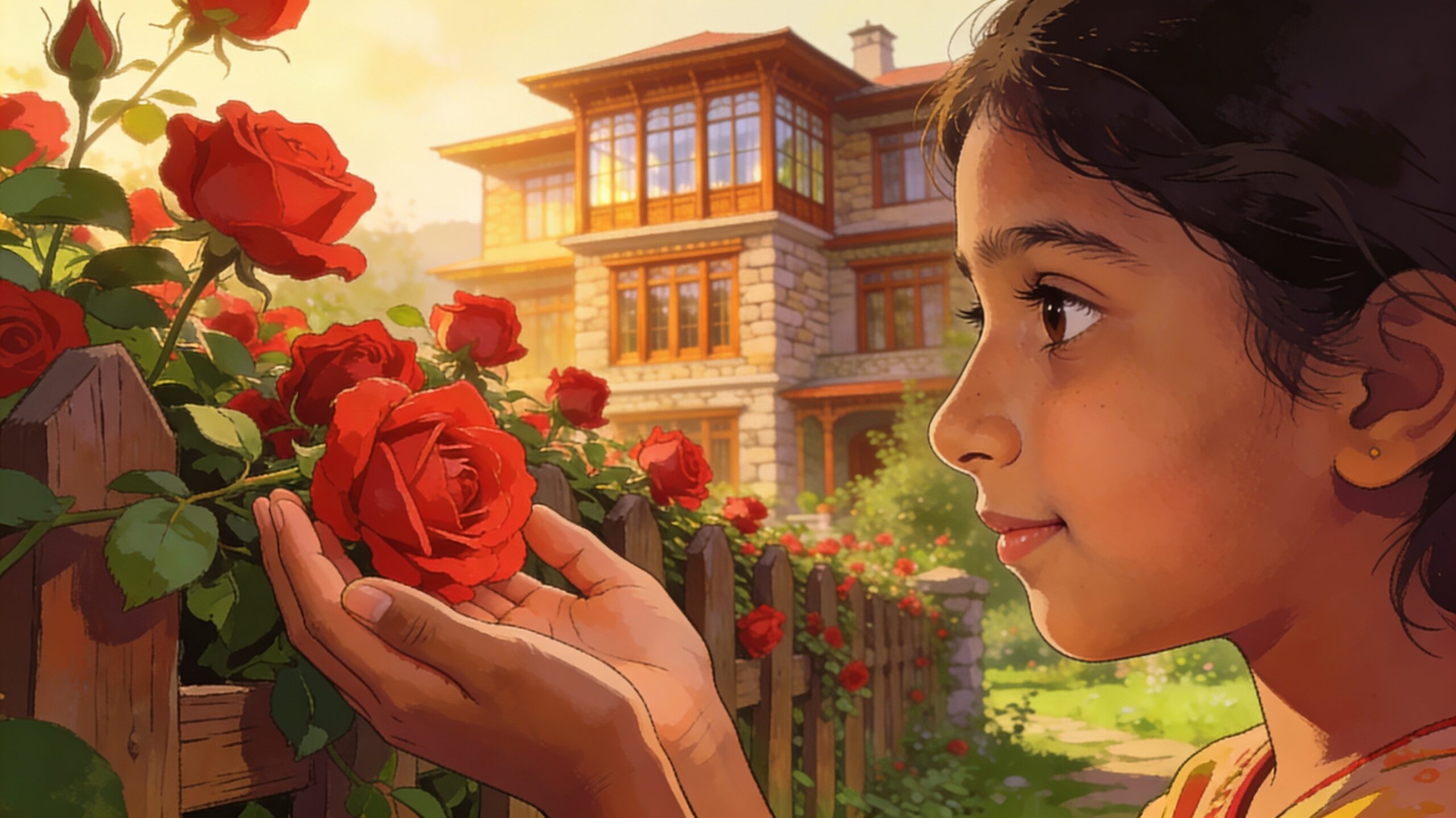
Beautiful red roses 🌹 covered the entire fence. My grandmother would not let us pluck them. We also had white, pink, and orange roses, or so I remember. Strawberries and cherries were counted by my grandmother so she could distribute them equally among us children. The garden was lush and large.
The kitchen had both a chulha and a gas stove. A black-and-white television had already arrived in our home. One day, while my uncle was busy at a nearby bhumi puja, we children orchestrated a plan to steal some money and buy Maaza. I knew where the money was kept, and since no one would suspect me, I sneaked in. While closing the door it made that telltale creak, but I slipped out anyway to meet my brother and the gang outside. My daadi called from behind, but I pretended not to hear, and we kept walking out of her sight, down a high pavement, taking a left turn toward the shops.
My brother had a Gold Spot. Now came my Maaza. My mouth was watering as the shopkeeper used a nail cutter to open the bottle cap. I held it in my tiny seven-year-old hands. The moment was ripe; the first sip was about to touch my taste buds, and suddenly a hand snatched the bottle away. I never got to taste it.
I was reprimanded. They initially thought it was my brother. My father waited with a leftover axe in hand, only for the dramatic effect as he couldn’t hurt a fly, in a carefully staged room with his grandmother and my grandfather present. As he began scolding us, I looked at my great-grandmother. She immediately pulled me behind her. My grandfather said, “She won’t do it again. No one will say a word to her.”
That was my first and last act of theft. And I waited another decade before I finally tasted a Maaza.
Kaakni and the First Lesson in Death
My great-grandmother Kaakni was breathing her last. I could see movement through the tall glass windows. She had lost control of her bodily functions, and my mother and uncle had been washing her for months before the final day arrived. Children were not allowed near her deathbed.
The other two children didn’t understand what was happening. I waited in the staircase and hushed them both: “She is dying. She is leaving this world. She won’t come back. Do you not understand what is happening?”
Somehow I knew she needed to be mourned. I tried crying in the days that followed, at school and elsewhere, as though it were the right thing to do. Looking back, I wonder how I knew about death even before witnessing it for the first time. Clearly, my soul knew far more than my mind could process then.
A Home Full of Life
Tiny fights and bickerings were, of course, commonplace in our little joint family. But I remember declaring on more than one rare occasion: “Fighting yields nothing. Why can’t we simply love each other? We are family. How difficult can it be?“
My chaachu would feed us children from the same thaali, dividing rice, vegetables, and non-vegetarian portions into three equal servings, each with a separate bowl of curd, carefully measured. Those memories are precious.
The camaraderie with our neighbours was beautiful. Let us not forget, we were saved by our Muslim neighbour. Had it not been for him, we would have long been dead.
Arriving in Jammu
After sixteen hours in the back of that truck, the door finally opened. Bright sunlight fell on my closed eyelids with an intensity I had never known in Kashmir. I could not open my eyes for a long time. When I finally did, the world had changed. No green fields. Scattered, isolated concrete structures. Forget snow; the sun blazed in a way I had never experienced before. But I embraced the light.
Eighteen people had fled together in that tiny truck.
Somehow, word had reached my father and uncles, who were waiting to receive us. We were taken past houses to a single hall at the far edge of Jammu city, which in honesty barely had a city feel at the time. One hall, a portion of which became our kitchen, the rest serving as the sleeping, eating, and living space for all eighteen of us over the coming weeks, until each family found a single room and gradually shifted out.
We were together, though. And I was happy.
That first night, I slept on the floor in the open with the other children. The searing heat caused a massive nosebleed, so heavy that my pink frock turned red. Some instinct told me to tilt my head back and apply pressure to stop the bleeding. I told my mother not to worry and that I would wash the frock myself in the small, makeshift washroom with a shawl for a door.
But I was glad. We had everything we needed, and the operative word is need, not want.
Every reason to be happy. We were alive, while so many had been butchered, raped, killed, hanged, and shot at point-blank range. We had an opportunity to rebuild. I began rebuilding at the very first ray of dawn. I saw it clearly as an opportunity, not an obstacle. The only mantra: one day at a time.
And now, from my spiritual practice, I know this is the only way to live, to be fully present. Not to fret over the past or fear the future. Just be. You can only truly be in the present moment. You cannot be in either the past or the future. In one you are lost in memory, and in the other, consumed by fear of something that is, in any case, beyond your control.
Patterns, Loops, and the Non-Receiving Syndrome
In Kashmir, if asked to wash dishes, I would demand my brother wash his share too. I was a crusader for gender equality from childhood. I hated being left behind when the boys flew kites, and I resented the separation of chores by gender.
Yet overnight, I was willingly washing blood-stained clothes and helping in every way I could. My family insisted I focus on studying and leave the chores to others. My parents prioritised my education above everything else.
We were eventually admitted to MIER, one of the largest schools in the city.
Day 1: Dad showed us how to travel alone in a matador minibus.
Day 2: He told us to go alone. We were excited and terrified, and boarded the wrong one. A few kilometres later, there was Dad, waving at the conductor to stop the vehicle. He got us off and dropped us to school. He had not abandoned us. He had been watching over us all along.
We never boarded the wrong matador again.
But before we found him, I had already mentally mapped out a plan: if we were lost forever, I would finance my brother’s education by singing and dancing on the streets, sacrificing my own future for his. I had already decided.
Looking back, I see this not as maturity but as the deeply conditioned pattern of a mature soul that has witnessed generational trauma. A belief that self-sacrifice is the highest form of love, that resources are finite, and that we must exhaust ourselves to provide for others. For forty years, I was a decorated warrior of my own story. Then the bubble broke.
I was a conditioned nourisher, following past-life patterns of sacrifice. I would bend over backwards in love without hesitation, until my Young’s modulus reached a breaking point, a point of no return. You will understand this more as the story unfolds.
We all carry our patterns. We are stuck in loops our minds have created. Mine was: love means sacrifice. High doership. I have to provide for all, and I can provide for all. I mistook this for confidence, not realising I had long since shut myself off from receiving anything from anyone.
I would not even let my husband or parents pay for me, let alone friends or extended family. In doing so, I was blocking abundance, because in order to give to me, the universe had only one avenue left: I had to earn it entirely myself.
I apologise to the universe, and to myself, for taking so long to recognise the undertone of these patterns. What appeared on the surface as confidence and independence was, in truth, what I now call a Non-Receiving Syndrome.
For infinity to flow, giving and receiving must be in balance.
The other pattern was thinking little of myself as a sign of humility. If I downplayed my achievements, I was the good girl, everyone’s favourite. This was a call to blend in, to fit into social patterns.
My name appeared in newspapers many times, and I never kept a single cutting, thinking that if I could do it, it must be easily achievable by anyone. I won debates. I became a karate champion in two martial arts. I saved girls on the street by being one of the finest self-defence fighters around. I was fearless, a school topper; I could sing and draw and dance. Above all, I thought of others constantly. I could give everything away if I felt someone needed it more. The last sip from my water bottle. The ₹10 saved after walking 5 to 7 kilometres home from school in the blazing summer heat. I would spend it without a second thought on juice for my cousins, so they didn’t dehydrate, so they felt special in my presence.
Before you are too impressed, allow me to offer some truth: this is the mark of a soul that has witnessed the darkest nights and concluded that it alone is responsible for all suffering. This is not only trauma. It is a high degree of ego wrapped in karta bhaav, in doership.
I wanted to be everybody’s saviour. But it was I who needed the saving.
The only saviour any of us has is ourselves.
I want you all to understand how spiritual realms and energy fields truly work, how quantum mechanics functions, and how so much of what we have historically glorified are, in fact, traps: unending loops quietly draining our energy while we remain unaware.
I will unravel this in the chapters ahead.
Wait for Part 3…






POST COMMENT