Thirty-five years after Chaman Lal Pandit left Kashmir in the winter of 1990, he returns to his family's house in Verinag, and finally listens to what it has been trying to tell him ever since. A story by Rajender Koul.
By Rajender Koul
The dialogue between Chaman Lal Pandit and his old house remains central to this story: an intimate, unfinished piece of yearning, assayed and composed from whatever connection still binds us to body and soil. It is the story of a soul that feels displaced within its own life, reckoning with every act and its essence under the shadow of exile. Now it comes enriched with the flashbacks of early childhood, the haunting night of a forced departure, and the tender rediscovery of roots.
A heartfelt conversation between the soul that left and the soul that stayed behind, told through Chaman Lal's own words, his will, and his wisdom.
The world outside was vast, yet incomplete. We built a new home, but it never spoke. The walls were quiet, the air unfamiliar. Festivals came and went, but the songs had lost their accent.
I grew older, became a man, a father. Life moved on, but a part of me remained frozen, standing before that wooden door, waiting for it to open again.
Sometimes, I'd dream of this house, standing proud against the mist, waiting for us. I'd wake up with tears on my pillow, the scent of damp wood still clinging to my mind.
Return: Rediscovering the Roots
Now, thirty-five years later, I was here again, before the same door, in the same valley, breathing the same air.
Old House: "And what of your college days? I heard your laughter echo through those years, somewhere far away."
Chaman Lal: "Sometimes, I wish I could go back to college, not to be a rebel, but to really understand what I studied, and what life was trying to teach me."
The old window trembled, as if smiling at the memory.
Old House: "Do you still remember your first job, the day you got your first pay cheque?"
Chaman Lal: "Yes. Sometimes I wish I could be a fresher again, not to do less work, but to recall the joy of earning that first honest coin. It felt like the world had finally opened its arms to me."
In the backyard, the almond tree still stood, aged, bent, yet alive. Beneath it, I could almost see my children's shadows, running, laughing, chasing butterflies.
Chaman Lal: "Sometimes, I wish my kids were younger, not because they grew fast, but because I want to play with them a bit more."
Old House: "You speak like time owes you more days."
Chaman Lal: "Maybe it does. Sometimes, I wish I had more time to live, not to have a longer life, but to know what more I could give to others before my dusk arrives."
The house trembled slightly as the wind passed through its broken windows, as though it too was holding back tears.
Old House: "Time never brings us back, my friend. But look, it gives you this moment. You and I, standing here, breathing what's left of memory."
Chaman Lal: "Yes," I whispered, "the times that are gone can never come back. But maybe, through remembering, we live them once more."
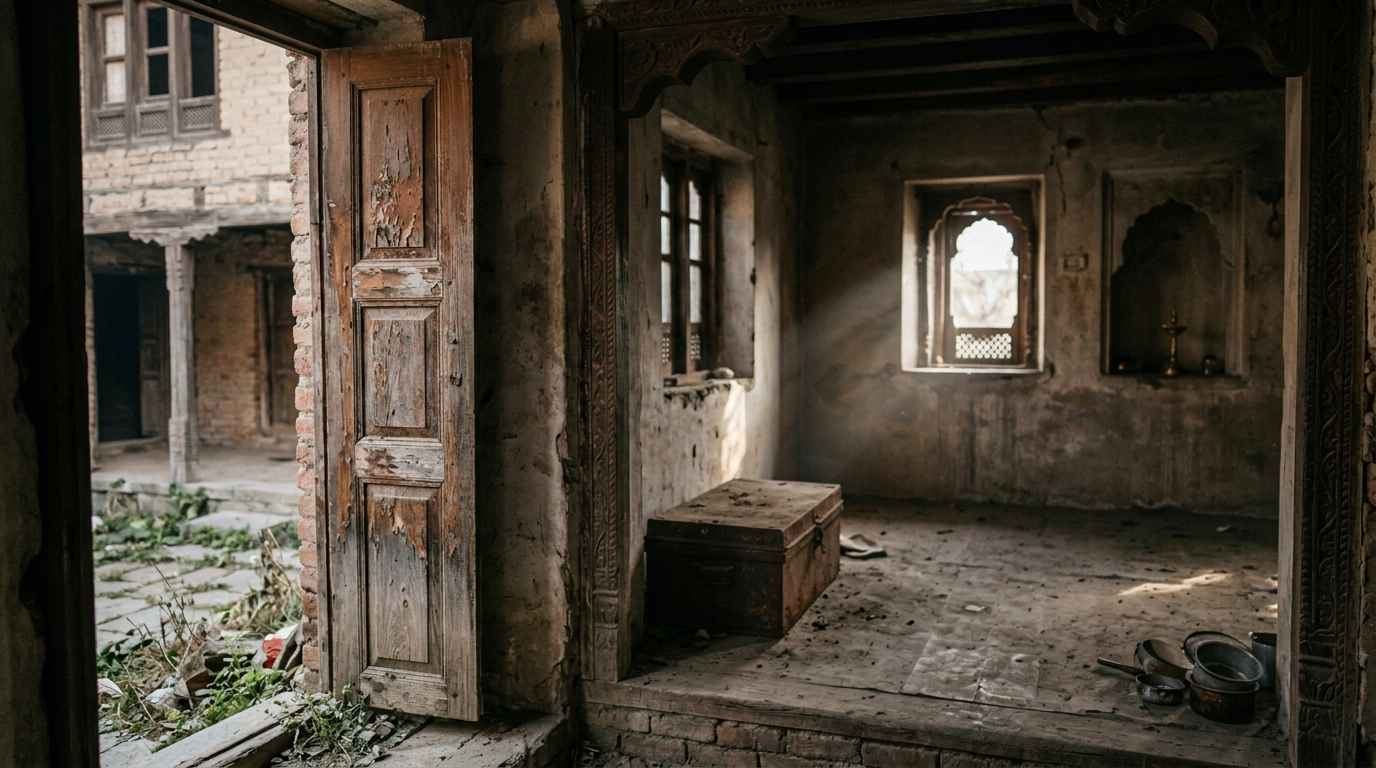
A tear rolled down, unnoticed, onto the dust-covered threshold. I placed my hand on the wall, cracked, cold, sacred.
Old House: "Then promise me one thing: don't wait another thirty-five years to come home again. The walls may fall, but the heart remembers."
Chaman Lal: "I promise. From now on, I'll live the moments as they come, to the fullest."
And as I turned to leave, the evening sun spilled golden over the rooftop, as if blessing our reunion. It was not just a visit. It was a reconciliation: a return of soul to its soil.
As continuity and spirit kept the vision intact, the house spoke of change: of the silence where prayer once lived, of longing for the family that built it, and of a yearning for peace and remembrance.
The walls may fall, but the heart remembers.
The Cry of the House
As twilight settled, I stood again by the threshold, ready to leave. The house was quiet, but its silence felt heavy: a silence not of peace, but of breath held too long.
Old House: "Before you go, there is something I must tell you."
Chaman Lal:(turning back) "What is it, my old friend?"
Old House: "I have changed. Not by choice. When you left, another family came, kind in their own ways, but strangers to my soul. They filled my rooms with new voices, new scents, new prayers, a different kind of ritual, never seen before. Yet sometimes I feel choked, as if the air that once carried mantras and bells has turned still and unfamiliar."
Its voice trembled, like wind through a broken shutter.
Old House: "Do you remember the Thokur Kuth, that little shrine near the inner wall? The lamp that your mother lit every dawn? It is gone now. The space has been reshaped for warmth and water, and the walls no longer echo with verses. The courtyard, where diyas once danced like stars, sees a different kind of fire now. The rhythms are other, the faith is other, and though I try, I cannot understand their language of devotion."
I could feel the ache in every word.
Old House: "I do not blame those who dwell here. They live by their own light, by their own choice. But I still remember another kind of brightness: the fragrance of incense, the sound of bhajans on the radio, your father's steady chanting, your mother's soft hymns on Shivratri nights."
A Homecoming to Kashmir
The air of Verinag hung heavy with silence that afternoon. The chinars, once flushed with crimson, had turned a weary amber. Their fallen leaves whispered like tired memories across the courtyard. I stood before the rusted iron gate, the same gate that once swung open to laughter, childhood, and home.
It had been thirty-five years. Thirty-five long, aching years. The gate creaked as I touched it, its metal cold but strangely alive beneath my palm. The house, wrapped in the stillness of neglect, seemed to recognize me before I spoke. And then, as if from the silence of its bricks, a voice rose, soft, fragile, and warm with remembrance.
On the cemented cornerstone, the old engraved board still read: Pandits Aagur, Babsund Anugreha.
Old House: "You've come back, after so many years. How, and why now? I am shocked, surprised, and excited too, I don't know how to welcome you, dear Chaman ji. I thought you'd forgotten me."
Chaman Lal:(nervous, in tears) "How could I forget you? Every wall of yours holds a story I still breathe."
Old House: "Then why so long? My courtyard waited. My windows looked out for you in every season. Even the wind that passed through me carried your name. You all left me alone, for no fault of mine."
Chaman Lal: "Life carried me far away, beyond the mountains, beyond the memories. But you, you stayed here, guarding the ghosts of our laughter."
The gate gave way with a reluctant groan as I stepped inside. The stone pathway, cracked and moss-covered, still carried traces of our footsteps. The wooden door, scarred and pale, sighed under my touch.
Old House: "Do you remember how your mother's anklets used to sing on these steps? How she would hum while making tea, her smile catching the first light of dawn. Your father, a towering man with a graceful voice, would recite his mantra jap on his way back from the Shiv temple, a daily routine I have missed all these thirty-five years."
Chaman Lal: "I remember. Sometimes, I wish I could go back in time, not to change things, but to feel them twice. To see her smile again, to feel her hand resting on my head, to listen to the sweet voice of a bhajan humming from my father, Bobji."
I closed my eyes, and the years folded back like the worn pages of a book.
The Days of Innocence
The house was alive then, filled with fragrance and voices. After his morning visit to the temple, Father's radio crackled with the news, while Mother stirred kahwa on the stove, its fragrance of saffron, cardamom, and cinnamon spreading through the rooms.
My sister's laughter echoed from the veranda as we chased each other around the almond tree. The winter sun filtered through the carved wooden lattice, painting our faces in gold.
I could still see myself, a boy with ink-stained fingers, sitting on the threshold with a school bag larger than his back, waiting for the tonga to take him to school.
In the evenings, the house glowed like a lamp. Neighbours dropped in unannounced, carrying stories and warmth. My grandmother would tell tales of Shiva's abode and the purity of the spring at Verinag. We listened wide-eyed, believing every word. And every night, as the frost descended and the distant temple bells rang, my mother would whisper softly, "Sleep well, my son. Tomorrow, we will pluck the first almonds of the season." That tomorrow never came.
The Night of Departure
Old House: "You left in haste that dark winter. You didn't even look back."
The memory returned sharp, raw, and heavy with the smell of fear. It was January, 1990. The valley was shrouded not in snow, but in dread. The streets that once echoed with laughter now trembled under silence.
That night, Father whispered, "We have to leave, tonight." Mother's eyes were red but steady. She gathered what she could, a few clothes, family photographs, the copper lota from the puja room, and a small portrait of Lord Shiva.
Outside, dogs barked endlessly. Somewhere, slogans tore through the night air, strange, terrifying words we didn't fully understand but felt in our bones.
As we stepped out, the house seemed to cry. The door moaned as it closed behind us. The almond tree swayed helplessly. The winter wind stung, and somewhere a dog kept barking after all the others had stopped.
I turned once, just once, to look back. The moonlight fell on the roof tiles, and I remember thinking, "I'll be back soon." But soon turned into decades.
The Lost Years
Old House: "Now I am only a witness to passing seasons, and each festival that returns without you makes me feel more hollow."
The chinar leaves rustled gently, as if comforting it.
Old House: "I fear that if you do not return, I too will fade, not in stone, but in spirit. Every place has a soul, and mine was born of your prayers, your laughter, your love. Come back sometimes, even if only to light one lamp in memory. Let me know I still belong to someone."
I felt a lump rise in my throat. The pain of exile was mine, but the house had lived another kind: the exile of being forgotten.
Chaman Lal: "I understand now. Home is not walls or ownership: it is remembrance. Even if I cannot take you away, I can keep you alive, in stories, in words, in every whisper of longing that still ties me to this soil."
Home is not walls or ownership: it is remembrance.
I bent down and gathered a handful of earth from the courtyard, cool, fragrant, sacred, and placed it gently in a small pouch.
Chaman Lal: "This is you," I said. "You will travel with me now. Wherever I go, a part of you will breathe again."
The setting sun washed the walls in gold, and for the first time, the old house seemed to sigh in relief.
Old House: "Then go, my son. Carry my memory kindly, not in bitterness but in love. We are both changed by time, yet bound by the same root. And remember: every diya you light there, I shall feel it here."
As I stepped back toward the gate, the wind rose softly, carrying with it a faint echo, the ringing of a temple bell that no longer existed, yet somehow still sounded in the heart.
It was a homecoming, a farewell, and a promise all at once.
For though time had divided us, memory had found its way home.
Rajender Koul, a resident of Talab Tillo, Jammu, is a retired officer from the State Bank of India. After decades of his first innings and very dedicated service in the banking sector, he now enjoys his second innings in the quiet rhythms of retired life. A keen observer of people and the world around him, Rajender Koul, has turned to writing as a way to reflect, create and reconnect with life’s deeper meanings. He spends his leisure time crafting short stories and capturing memories, experiences and moments that often go unnoticed in the everyday hustle. Through his thoughtful storytelling, he seeks to preserve personal and collective journeys of spiritual growth, humane love, loss, resilience and hope. Prayers and blessings a support to the world of ours we live. Jai Bhagwan ji
We value your privacy. To improve your experience, we use cookies and similar technologies for the following purposes:
- Essential functions: These cookies make the site work properly and keep it secure.
- Analytics: These cookies help us understand how the site is used and improve performance.
- Personalisation and marketing: These cookies show relevant content and measure engagement.
You can choose which categories to allow. Your preferences will be saved for future visits, and you can change them at any time in Cookie Settings.
This website uses cookies
Websites store cookies to enhance functionality and personalise your experience. You can manage your preferences, but blocking some cookies may impact site performance and services.
Essential cookies enable basic functions and are necessary for the proper function of the website.
Name
Description
Duration
Cookie Preferences
This cookie is used to store the user's cookie consent preferences.
30 days
You can find more information in our Cookie Policy and .









POST COMMENT