
Lotus Stems and Temple Bells

“Yadā yadā hi dharmasya
glānir bhavati bhārata
abhyutthānam adharmasya
tadātmānaṁ sṛjāmy aham”

Bhagavad Gita 4.7

Whenever righteousness declines and unrighteousness rises, Krishna promises to appear.

For me, this “appearance” has always been more than a verse. It is something I have seen celebrated in two distinct yet harmoniously intertwined ways: the Kashmiri Pandit tradition of Zaram Satam and the vibrant temple festival of ISKCON.

Part 1: The Janmashtami of My Ancestry – Zaram Satam

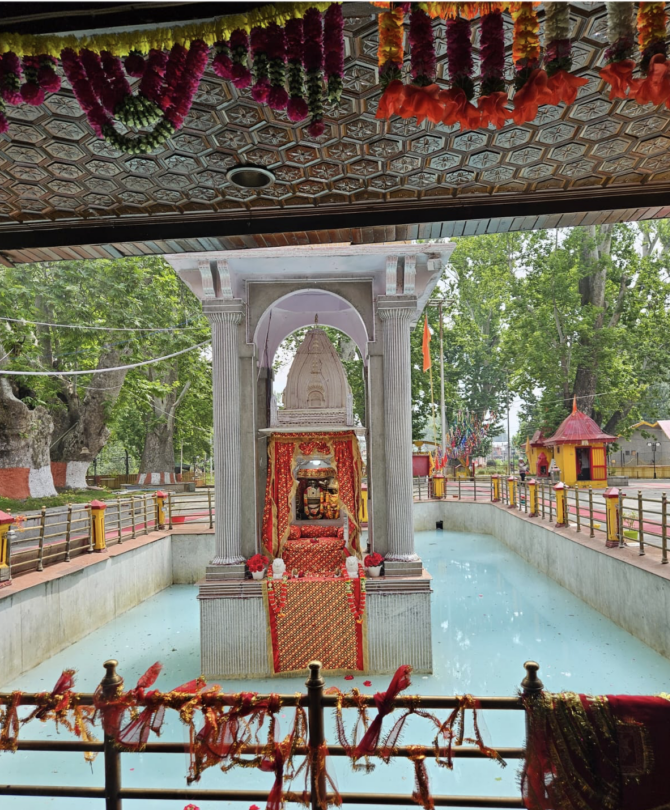
In my extended family, August often arrives with the scent of lotus stems, fresh nadru and the gentle murmur of Zaram Satam—the Kashmiri Pandit way of marking Janmashtami. I have mostly experienced it in the homes of my aunts, where tradition lingers in the smallest details, and in the vivid stories my mother told me of her own childhood celebrations. Much of what I know and what I practice comes from her voice and hands, teaching me the meaning behind each ritual.

Preparations begin a day earlier. Dried marigold garlands are tied with care, hymns in Kashmiri drift softly from the kitchen, and the air fills with the aroma of feasts. My mother would explain why each dish was made, how nadru symbolised the bounty of Kashmir’s waters, or how the marigold’s saffron hue was considered auspicious. A low wooden table is covered in a white cloth, adorned with flowers, clay lamps and a copy of the Bhagavad Gita or Bhagavad Purana, pages turned with reverence.

The fasting goes on …fruits, tea, nadru monj and aloo churma are served as gaer oat (chestnut flour) takes centre stage, with the fast continuing until after midnight. Oil lamps (diyus) cast a warm glow as elders recount the story of Krishna’s birth—how Vasudeva carried the divine child through the flooded Yamuna.

At midnight, offerings of nadru, walnuts, almonds, honey and milk—foods from the Kashmiri land—are placed before Laddu Gopal. My mother taught me how to arrange them with care, explaining that devotion is as much in the details as in the prayer. The mood is not one of noisy festivity but of deep, enduring devotion, the kind that feels like it has been passed down through centuries unchanged—and through my mother’s heart, preserved for me to carry forward.

Part 2: The Janmashtami of My Journey – ISKCON

If Zaram Satam is the gentle glow of a single lamp, ISKCON’s Janmashtami is a hall blazing with light. My father, deeply drawn to the path of bhakti, brought ISKCON’s devotional traditions into our family life. Through him, I came to know another way of welcoming Krishna—one that felt both deeply rooted and boundlessly global.

Some of my earliest memories are of temple Janmashtamis when I was dressed as Krishna for the children’s dramas. My mother would spend the afternoon braiding my hair, adjusting the peacock crown and making sure my flute sat just right in my hands. She would wake me at 3:30 a.m. for mangal aarti, her gentle voice breaking the night’s quiet, wrapping me in a shawl before we stepped into the cool dawn air. The weeks of rehearsals were as joyful as the festival itself—running around with other children in peacock crowns, practicing lines and waiting for our turn on stage. For a child, it was pure magic: the music, the costumes, and the feeling of being part of Krishna’s story, not just hearing it.

In ISKCON, Janmashtami is celebrated from dawn until well past midnight. Fasting is complete—no grains or beans—seen not as deprivation but as a mindful offering to Krishna. The temple transforms into a tapestry of flowers, lights and fragrance, with volunteers in saffron or bright saris stringing garlands, cooking and arranging altars.

The abhishek—the ceremonial bathing of the deities—has always held me spellbound. Radha and Krishna, dressed in dazzling attire, are bathed in milk, yogurt, ghee, honey and rosewater, each liquid carrying a blessing. The mridangas and kartals grow in rhythm, the chanting of Hare Krishna swells like a wave and the line between singing and prayer disappears.

For ISKCON, Janmashtami is not simply an anniversary; it is the “appearance day” of the Supreme Personality of Godhead—a living, eternal moment that can be entered into each year. At midnight, the curtains open to reveal Krishna adorned with cascading garlands and sparkling jewels, as the chhapan bhog—56 dishes—are offered with devotion.

Two Paths, One Heart

One carries the quiet, place-bound devotion of the Kashmir valley; the other radiates the expansive, joyful energy of Vaishnava bhakti.

Both whisper the same truth: that Janmashtami is more than a calendar date—it is a reminder that the divine can appear anywhere: in a prison cell in Mathura, in a Kashmiri courtyard glowing with diyus, or in the chanting hearts of a temple hall.

For me, Zaram Satam and ISKCON’s Janmashtami are not separate streams, but two rivers flowing into the same ocean—the ocean of love for Krishna. Each August, I stand at their meeting point, grateful for the inheritance of both.

If my father brought Krishna’s presence into our lives, my mother ensured it flourished—through her storytelling, her rituals, and her quiet devotion. It was through her voice that I first heard the Kashmiri tales of Krishna’s birth, and through her patient hands that I learnt the rhythms of seva, the scent of incense, the care in offering bhog. Even though my father’s spiritual journey meant we lived apart, my mother learnt ISKCON’s ways over time and preserved them alongside the Kashmiri traditions she had known since childhood. In her devotion, both cultures found a home, and in her love, they became mine.

Hare Krishna Hare Krishna Krishna Krishna Hare Hare
Hare Rama Hare Rama Rama Rama Hare Hare

Moksha Laxmi, PhD, is a postdoctoral researcher at the Scheie Eye Institute, University of Pennsylvania, where she studies the genetic basis of glaucoma and eye disorders. Originally from India, she now juggles life in the lab with the joyful chaos of raising twin toddlers. When she’s not decoding genes or negotiating nap times, she enjoys cooking up creative recipes and creating decorative arts.

6 Comments

  • Sheetal

    Moksha, this was such a beautiful and heartfelt piece. I love how you wove together the gentle intimacy of Zaram Satam with the grandeur of ISKCON’s Janmashtami. Reading it brought back vivid memories of the elaborate temple celebrations I’ve experienced through you and Masi; the riot of colours, the wave of kirtans that seem to draw everyone into one heartbeat, the mesmerising abhishek and of course, the midnight darshan when the deity curtains open and the atmosphere feels almost electric with joy.

    It’s true what you say, while the Kashmiri tradition carries such a serene depth, ISKCON’s style radiates an expansive, almost otherworldly energy. I remember being awestruck at the sheer scale of devotion in those celebrations. It all felt like stepping into a living festival of the divine.

    Your words reminded me that whether celebrated quietly at home or in the exuberance of the temple hall, Janmashtami always whispers the same truth: that Krishna’s presence is everywhere, waiting in devotion-filled hearts. Thank you for rekindling those memories so vividly.

    • Moksha

      Thank you, Sheetal, for giving us a beautiful platform like ISBUND to share and cherish our traditional cultural pieces. It keeps us connected and gently reminds us of our roots.

  • Kulbhushan Sharma

    Very beautifully written. kudos to you Moksha. Keep it up.

  • Rahul Kaul

    This beautifully written piece stirred something deep within me. As someone rooted in Kashmiri Pandit heritage, the vivid portrayal of Zaram Satam brought back cherished memories of quiet devotion and ancestral warmth. The contrast with ISKCON’s vibrant celebrations was equally moving—showing how tradition evolves yet remains anchored in love for Krishna. Thank you for capturing both the intimacy and grandeur of Janmashtami so eloquently. Truly a soul-touching read.

    • Moksha

      Thank you so much for your thoughtful words, Rahul bhaiya. I’m truly touched that the piece resonated with your memories and heritage.

POST COMMENT

Your email address will not be published. Required fields are marked *