There are some nights in the history of people that never really end. They remain suspended between memory and nightmare—returning when winter winds blow through an unfamiliar window, when the fragrance of burning firewood reminds an old man of his childhood courtyard, when a mother prepares kehwa or noon chai in a kitchen far away from the land where she learnt to make it, when a grandfather tells his grandchildren about a home they have never seen.
For the Kashmiri Pandit community, the night of 1990 became such a night—a night that ended one chapter of life and began thirty-six years of exile.
This is the story of one such Kashmiri Pandit family from a village near Sumbal in the Valley. Their names may be fictional, but their emotions belong to thousands of families whose lives were uprooted during those terrible years.
The Home They Knew
The family lived in a modest ancestral house surrounded by walnut and poplar trees. In spring, the valley turned to blossoms; in summer, the fields shimmered in the afternoon sun; in autumn, the chinars glowed golden-red; in winter, snow-covered the rooftops. The Kangris beneath pherans, kehwa, noon chai and long evenings around the warmth of the bukhari.
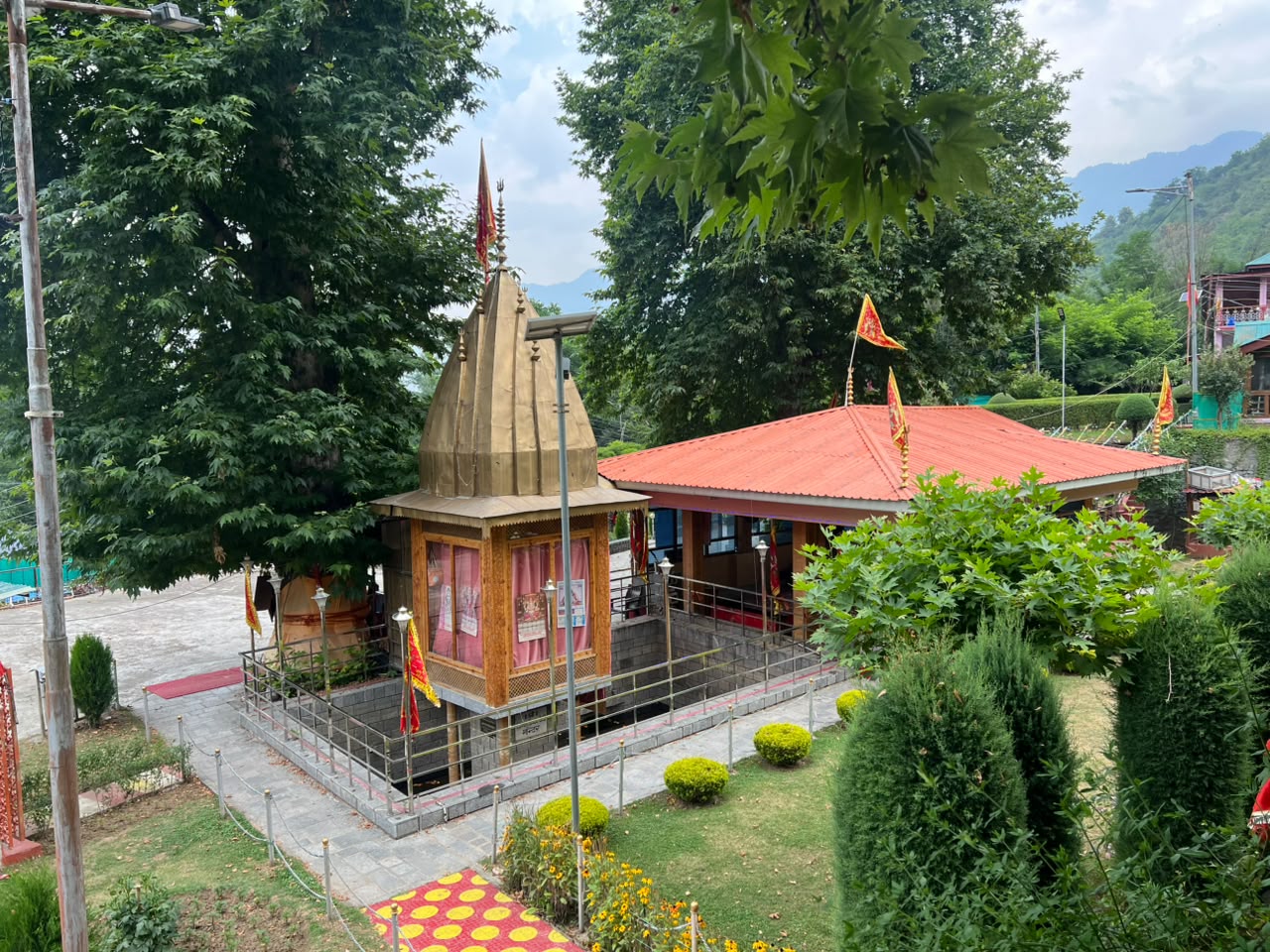
In one corner of the house stood the family's little Thokur Kuth—the sacred prayer room where generations had bowed before Bhagwan Shiva and Mata Sharika.
The head of the family was Shiv Nath Kaul, a disciplined and self-respecting man who believed that character was greater than wealth. His wife Shanta was the quiet strength of the household. Their children, Raghav and Sharika, were growing up in the ordinary rhythm of Kashmiri life.
The azaan from the neighbourhood mosque and the ringing of a temple bell were familiar sounds. Muslim and Pandit families had lived beside one another for generations. Their children went to the same schools, played together and knew each other's homes. Abdul Rahman was a neighbour. Ghulam Nabi would sometimes borrow farming tools from Shiv Nath. Fatima and Shanta exchanged vegetables and recipes.
At the level of ordinary human relationships, life still appeared familiar.
When Everything Changed
But beneath that apparent normalcy, something had begun to change. The conversations became quieter. Newspapers carried increasingly disturbing reports. Fear began entering homes before it entered conversations. Doors were locked earlier. Parents waited anxiously for their children to return. Men began speaking in whispers. Shiv Nath noticed all this but tried to conceal his anxiety from his family.
One evening Shanta looked at him and asked, "Something is wrong, isn't it?"
He remained silent.
"Things are changing," he said.
"Will we have to leave?" The question pierced him. "No," he replied. "This is our home." He believed those words when he spoke them. Perhaps he needed to believe them. But history had begun moving faster than hope.
The atmosphere deteriorated. Threats, fear and violence transformed the psychological landscape of the Valley. For families like Shiv Nath's, the question was no longer simply whether they wanted to leave. It became whether remaining was safe. Then came that terrible night when the family realised that the home they had known for generations could no longer guarantee their safety.
The Night of Departure
Shanta entered the Thokur Kuth. She lit the small lamp before Bhagwan Shiva and Mata Sharika. Her hands trembled as she folded them. "Mother," she whispered, "we are not abandoning you. We are leaving because we have been forced from our home. You must come with us." She wrapped a small idol in red cloth.
Shiv Nath stood silently at the doorway. They began packing. There was hardly anything they could carry.
A few clothes. Some documents. A handful of photographs. A little jewellery. A few religious books. Some family records. The idol of Shiva. Everything else remained.
The walnut tree remained. The courtyard remained. The kitchen remained. The books remained. The photographs remained. The memories remained. The ancestors remained. The house remained locked.
Shiv Nath turned the key. He stood looking at the door for a long time. Perhaps he knew that he was not merely locking a house. He was locking away a part of his own life. The family walked away. Sumbal remained behind.
The road ahead was uncertain. They only knew that they had to survive. And that was how an ordinary family became a displaced family in its own country.
Rebuilding Through Education
The journey to Jammu was not a journey of choice. It was a journey of compulsion. When they eventually reached Jammu, they found themselves living in conditions they had never imagined. The family that had once possessed an ancestral home, land, books, memories and a settled identity now had to begin again.
But Shiv Nath refused to surrender. He found work. He worked wherever he could. He endured heat his Valley-born body had never known. He learned to live with uncertainty, to hide his worries, to smile when there was very little to smile about. Most importantly, he made one promise to himself: his children would not be allowed to lose their future merely because their parents had lost their home.
Whenever Raghav needed books, he somehow arranged them. Whenever Sharika needed school fees, he found the money. Whenever the children complained about hardship, he reminded them that education was a possession no one could take away. "Study," he would tell them. "Our house was taken from us, but nobody can take away your knowledge."
Those words became the family's philosophy.
The children studied. They grew. They entered colleges. They built careers. They married. They travelled. They established themselves in different parts of India and the world. The family that had lost its physical home slowly rebuilt its life through education, hard work and self-respect.
The Room That Belongs to Kashmir
But something inside Shiv Nath never changed. Every winter he would remember Sumbal. Sometimes he would sit quietly and ask, "Do you remember the walnut tree?" "Yes, Baba." "The stream?" "Yes." "The old temple?" "Yes." And everyone understood that he was not really asking about a tree, a stream or a temple. He was asking whether his children remembered who they were.
Thirty-six years can change almost everything. Children become parents. Parents become grandparents. Temporary accommodation becomes a permanent house. A migrant colony becomes a neighbourhood. A person who once arrived with one suitcase eventually fills cupboards with possessions. But there is one thing exile cannot easily replace: belonging.
A Kashmiri Pandit may build a beautiful house in Jammu, Delhi, Bengaluru, Pune, Mumbai, London, New York or Melbourne. His children may become doctors, engineers, professors, scientists, administrators, entrepreneurs and professionals. He may travel around the world, achieve everything society calls success.
Yet somewhere within him there remains a room whose key belongs to Kashmir.
That room cannot be opened by money, cannot be replaced by compensation, cannot be recreated by photographs. It exists in memory. And memory can be both blessing and burden.
A Message to the Nation
Shiv Nath did not want his children to live their lives consumed by bitterness. But neither did he want them to forget. "Remember what happened," he would tell them, "but don't allow what happened to destroy what you are." That was perhaps his greatest inheritance. Not hatred. Not revenge. Memory with dignity.
There were times when he felt that the deeper emotional wound of the community remained insufficiently understood. Government records do document relief and rehabilitation measures for registered Kashmiri migrant families, but for families such as his, administrative assistance could never by itself answer the larger questions of belonging, justice, cultural continuity and the fate of their ancestral homes.
For Shiv Nath, a relief camp could provide shelter, but not a childhood. A financial package could help a family survive, but not restore an ancestral courtyard. A new house could provide four walls but not reproduce the smell of the old kitchen. An official file could record a displaced family, but never contain the emotional weight of exile.
This distinction was at the heart of his pain. He did not want charity. He wanted dignity. He would not have his children remain permanent refugees in their own country.
He wanted them to know that the land from which their ancestors came had not become irrelevant merely because history had forced them away. And whenever human institutions failed to provide satisfactory answers, Shiv Nath turned towards Bhagwan Shankar. Every Monday he visited the Shiva temple. He stood before the Shivling, closed his eyes and prayed. He did not ask Mahadev for wealth. He did not ask for revenge. He asked for strength.
Not merely through buildings. Through memory, prayer, language, food, stories. Through grandparents. Through children taught where they came from. This is how a civilisation survived exile.
One evening, many years later, Shiv Nath sat among his grandchildren. A little boy looked at him and asked, "Dadu, where is our real home?" The old man looked at him for a long time. "Our home is wherever Bhagwan keeps us," he finally said. The boy thought for a moment. "Then why do you always say Kashmir is our home?" Shiv Nath's eyes filled with tears. He placed his hand upon the child's head. "Because, my son, a tree can grow in another soil, but its roots remember the first earth."
They were forced to leave, but they refused to disappear. They lost homes, but they built homes again. They lost property, but they invested in education. They lost security, but they preserved dignity.
The Lamp Still Burns
Thirty-six years later, the children of that generation have grown up. Many have achieved remarkable success. They have contributed to the economy, the professions, the armed forces, science, education, business, administration, medicine, technology and every other sphere of national life.
They have asked for little except the right to remember. They have carried their parents' wounds without allowing those wounds to destroy their future. They have educated their children. They have built houses. They have created institutions. They have preserved temples, traditions, language and festivals.
And through all these years, they have continued to believe that the India they belong to must ultimately be a country in which no community is ever again made to feel that it has become a stranger in its own homeland.
The lamp that Shanta carried from the Thokur Kuth that terrible night did not go out. It travelled with the family. It burned in the migrant camps. It burned in rented rooms. It burned in new houses. It burned beside children's schoolbooks. It burned during Navreh. It burned during Herath. It burned in temples far away from Kashmir. And thirty-six years later, it still burns.
That lamp is memory. That lamp is faith. That lamp is resilience. That lamp is the hope of return.
And perhaps most importantly, that lamp is a message to Bharat. Never allow the darkness that once consumed one community to become the darkness that awaits another. For the night may have driven a family away from Sumbal, but it could never drive Sumbal out of the family. And as long as that memory survives, the story is not over.
Kashmir is remembered. Kashmiri Pandits endure. Bharat must remember. And humanity must never forget.
What happened to one community must become a national lesson about protecting every community from forced displacement, violence and loss of dignity.
Rajender Koul, a resident of Talab Tillo, Jammu, is a retired officer from the State Bank of India. After decades of his first innings and very dedicated service in the banking sector, he now enjoys his second innings in the quiet rhythms of retired life. A keen observer of people and the world around him, Rajender Koul, has turned to writing as a way to reflect, create and reconnect with life’s deeper meanings. He spends his leisure time crafting short stories and capturing memories, experiences and moments that often go unnoticed in the everyday hustle. Through his thoughtful storytelling, he seeks to preserve personal and collective journeys of spiritual growth, humane love, loss, resilience and hope. Prayers and blessings a support to the world of ours we live. Jai Bhagwan ji
Beautifully written!! However, was looking for more depth into why KPs were forced to leave. I hope the next one could get deeper into the sacrifices and reality of what was happening back then. Thank you!
We value your privacy. To improve your experience, we use cookies and similar technologies for the following purposes:
- Essential functions: These cookies make the site work properly and keep it secure.
- Analytics: These cookies help us understand how the site is used and improve performance.
- Personalisation and marketing: These cookies show relevant content and measure engagement.
You can choose which categories to allow. Your preferences will be saved for future visits, and you can change them at any time in Cookie Settings.
This website uses cookies
Websites store cookies to enhance functionality and personalise your experience. You can manage your preferences, but blocking some cookies may impact site performance and services.
Essential cookies enable basic functions and are necessary for the proper function of the website.
Name
Description
Duration
Cookie Preferences
This cookie is used to store the user's cookie consent preferences.
30 days
You can find more information in our Cookie Policy and .








Pooja Kaul
Beautifully written!! However, was looking for more depth into why KPs were forced to leave. I hope the next one could get deeper into the sacrifices and reality of what was happening back then. Thank you!