
Prashant Pandita on The Jehlum Boys and Kashmir
When personal tragedy coincides with professional upheaval, some people retreat inward, but for Prashant Pandita, the result was a deeply personal debut novel set against the turbulent backdrop of his homeland, Kashmir. The Jehlum Boys is both a coming-of-age story and a poignant reflection on a fractured past, shaped by the mass exodus of Pandits in 1990.
Drawing from vivid childhood memories, school friendships, and the bitter realities of displacement, Pandita crafts a narrative that is as intimate as it is political. In this conversation, he opens up about what inspired him to write the book, the real-life encounters that informed the story, why his characters’ diverging paths reflect a generational truth, and why stories from conflict zones can only be authentically told by those who have lived them.
What inspired you to write The Jehlum Boys and set it against the backdrop of Kashmir?
I always enjoyed writing and considered myself quite good at it. Since childhood, I would participate in various writing competitions, and even after starting my career, I continued to write and engage in competitions. However, the idea of writing a book, and that too of more than 1 Lakh (100,000) words, had never crossed my mind, even in my wildest dreams.
It all happened in 2018 when my mom passed away. Unfortunately, during the same time, there were some changes at my company which were not in my favour. So a double whammy of sorts. It was the most tumultuous period of my life, and I felt lost and frustrated, as if I were losing my grip on everything around me. It was then that the thought of writing something that would engage me for an extended period came to my mind.
Since I started writing as a means to distract myself from those overwhelming thoughts, I didn’t set a deadline, as completion wasn’t the main goal. It was only during the COVID-19 pandemic that I realised I could now focus on completing the book.
As a writer, especially a debut writer, one tends to write about subjects that are close to one’s heart and that one can describe in detail. Kashmir and friendship fit the bill perfectly, which is why I chose them as the central theme of my book.
The friendship between Nishant and Mudassir is at the heart of your novel. Why was this bond so important to your narrative?
A little backstory first: I was posted in Bangalore in the early 2000s, and my job required me to travel a lot. During one of my trips to Chennai, I noticed a magazine (Outlook) on a table in the hotel lobby that had a cover photo of a man who looked familiar. The headline called him a terrorist. I took the magazine back to my room, and as I read the article, I was shocked to discover that the guy on the cover was a school friend. He was one of the nicest boys in our class, so it was totally unexpected and shocking to read such a thing about him.
Life moved on, and I completely forgot about the article. Years later, when I thought about writing a book, Kashmiri Exodus (for obvious reasons), and for some strange reason, that article was the first thing that came to mind. I began to wonder how such a nice boy could have picked up a gun. Perhaps he wanted to return to a better path. These thoughts began to cloud my mind. It was then that I decided to combine the two ideas and friendship seemed like the most logical way to do that and describe their individual journeys. This is how ‘The Jehlum Boys’ was conceived.
How much of the story was reconstructed from your own recollection of the past?
I would say a substantial portion of the first part of the book -particularly the childhood part – Biscoe School, fun, regattas, movies and then the events of 19 January 1990, and the migrant camps in Jammu.
While the story as a whole is not autobiographical, these segments in the first half draw heavily from my own experiences or from those who have experienced them firsthand. I can say that I didn’t have to stir my creative juices much for this part, as most of the material was already present somewhere in my mind.
Nishant and Mudassir find themselves on dramatically different paths after the exodus. Why did you choose these trajectories for your protagonists?
It wasn’t very difficult. These are the trajectories that most of the Nishants and Mudassirs followed in the 1990s: if you know what I mean.
How did you manage to keep the story focused on the personal without letting the political context overshadow it?
This wasn’t easy. I was navigating a tightrope and a small slip could have altered the narrative, potentially making the story controversial. That was my main worry because, as a working professional, I couldn’t afford that.
The best way was to keep the focus solely on the friendship and their journeys. However, I must admit that when you write the journeys of Nishant and Mudassir, who in a certain way represent their respective communities, a few topics with political undertones will inevitably crop up.
After completing the book, I immersed myself in a meticulous proofreading process, reading through the pages repeatedly. Despite all my efforts, I ultimately found it necessary to eliminate specific episodes and chapters that, while intriguing, could have sparked controversy and skewed the narrative in favour of one protagonist’s perspective over another.
How have readers, especially Kashmiris, responded to your book? Is the feedback more sympathetic towards Mudassir or more proud of what Nishant has achieved, have your readers delved on these paths?
Surprisingly, the feedback from Kashmiris in Kashmir has been mostly positive, while the responses from Kashmiris living in other regions have been mixed and somewhat complex. A few of them believe that, although Nishant’s trajectory is very well defined, I have, in some way or inadvertently, justified Mudassir’s trajectory, which I don’t think is the case. But all feedback is welcome. Regarding writing style, most feedback has been positive from everyone (touch wood).
Looking back, is there anything about the story or characters you would change?
I would not like to change the story or characters, but I would perhaps make it shorter and crisper. Pitching my book to agents and publishers was very challenging, as many told me that no one was interested in a debut author’s novel with 1.5 Lakh (150,000) words. After much struggle and editing, I reduced it to 1.1 Lakh (110,000) words, but still faced a lack of interest from agents and publishers. I was reluctant to edit further because I felt that it would compromise the essence of the story, which I did not want to change. In hindsight, making it a bit shorter might have helped me find a publisher more quickly. It took me over a year to find one.
What advice would you give to aspiring writers, particularly those seeking to tell stories from conflict zones?
When I completed writing my book, one of my author friends told me that I had finished the easiest part of the journey. At the time, I didn’t fully understand what she meant, but now I do. Pitching a book is an entirely different ball game altogether. I’ve met authors who completed their books five, ten, or even fifteen years ago (yes, you heard that right) and are still struggling to find a publisher. My advice is to start looking for agents once you have completed about 75% of your manuscript. They typically ask for a synopsis of the story and read two or three chapters to make their decision. This approach can increase your chances of securing a publisher more quickly once you finalise your manuscript.
If you want to write stories set in conflict zones, it’s important to establish your limits first. This subject can be a double-edged sword and you are bound to upset some people in the process, even if your story focuses on non-political themes like love or family feuds, etc. Conflict zone politics will inevitably come into play in some way. Also, if you are currently employed, I recommend avoiding controversial statements or topics and sticking closely to your main story. Getting caught up in controversy is probably the last thing you’d want your employer to discover.
Having said that, I personally believe that you can only tell a story about a conflict zone if you have been a part of that conflict. It should come from the heart. For example, I, sitting in Mumbai, cannot write a story based on Syria or Afghanistan. While the internet has made the world feel smaller and all the information is available at the click of a button, I still feel that some topics should only be touched if you have lived through them.
What message do you have for ISBUND readers, many of whom share a background of migration and resilience?
I want to wish them all the luck and encourage them to continue their remarkable journey in making our community proud. My heart swells with pride as I witness the incredible achievements of Kashmiris over the past 35 years. Despite facing immense challenges and being uprooted from their homes, they have risen like phoenixes, demonstrating resilience and determination that is truly inspiring. Respect.
Are there any upcoming projects or stories you’re excited to share?
Well, I have a handful of ideas swirling in my mind, but they are all in the seed stage. Currently, I don’t know which one will blossom into a story and compel me to pick up the pen again.
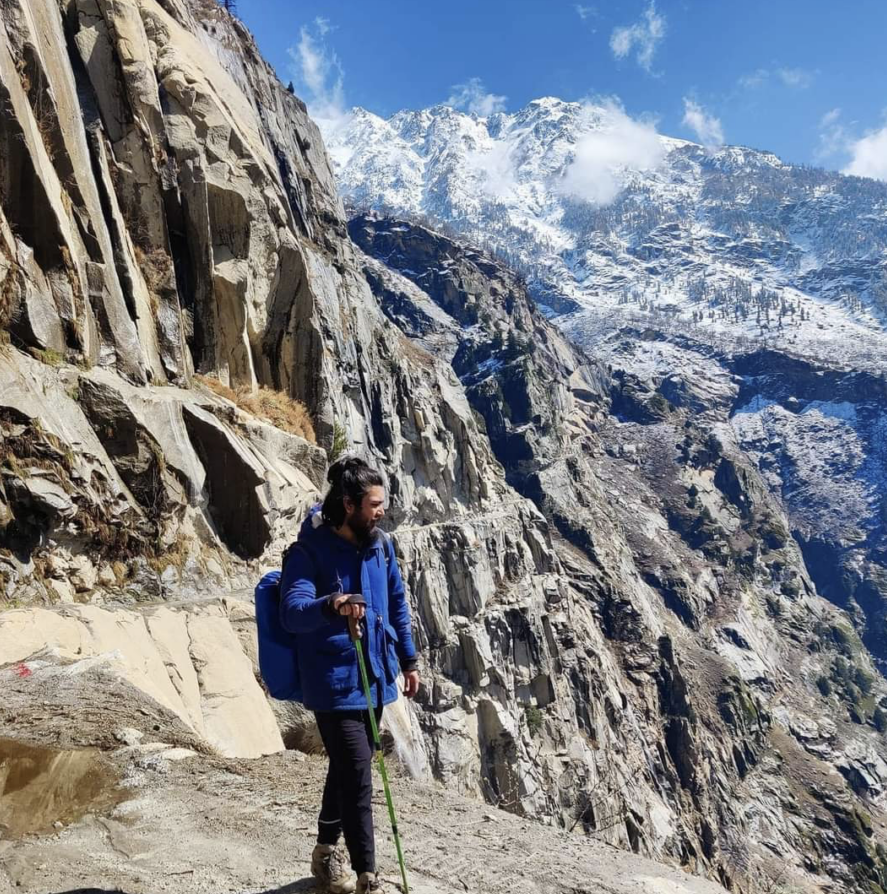
Prashant Pandita is a fun-loving individual who, when not making sales plans, is busy weaving stories. An engineer by profession but a writer at heart, he believes that every face tells a story. Though his children see him as perfect and his wife finds him a bit clumsy, he feels he lies somewhere in between—perhaps leaning slightly toward his wife’s perspective.
In his leisure hours, Prashant enjoys sipping tea and immersing himself in books. A keen observer of life, he is most fascinated by its certainty of uncertainty. He firmly believes his presence in Maharashtra is the result of cosmic design. Unable to settle in the land of Lord Shiva, he feels blessed that Lord Ganesha welcomed him to His own land, where he has been nothing short of pampered as a guest.
Sheetal Raina
Dr. Sheetal Raina is the founder and editor of ISBUND, an immersive platform dedicated to preserving and celebrating Kashmiri culture. Deeply connected to the heritage and traditions of Kashmir, she brings a distinctive voice to cultural discourse - blending academic insight with heartfelt commitment to her roots.
Related Posts
Travel Essentials and Oddities
Our travel essential survey results were awesome, a snapshot of the be
Songs From Nothing: The Endangered Art of Being Bored
In a world obsessed with constant stimulation, Songs From Nothing expl
The ‘C’ Word? Oh, You Mean Cancer – Let’s Talk About It!
Discussions around cancer awareness and prevention can sometimes gener
Maximising Your Weekends?
One of the reasons, working professionals can’t travel much for leis
London Marathon
If life is a marathon, then might as well make it London Marathon.&nbs
Recipe: Gaad-Nadur
Sharing a recipe of gaad-nadur as I have learned over the years. It is


POST COMMENT