A Story of Sacrifice, Memory, and Redemption
This humble work of attempting to write a piece is dedicated to the daughters of our community…those silent pillars who carry families upon their shoulders without ever asking for recognition. To the daughters who sacrificed their youth for the dreams of their brothers. To the daughters who endured migration, hardship, and loneliness with quiet dignity. To the daughters who proved through their lives that strength does not always shout; sometimes it simply endures.
May not a single sacrifice made by our daughters ever go to waste.
In the quiet lanes of an old Kashmiri Pandit neighbourhood in Srinagar, where ancient chinar trees stood like silent witnesses to centuries of life, there once lived a family whose story resembled that of countless others in the valley.
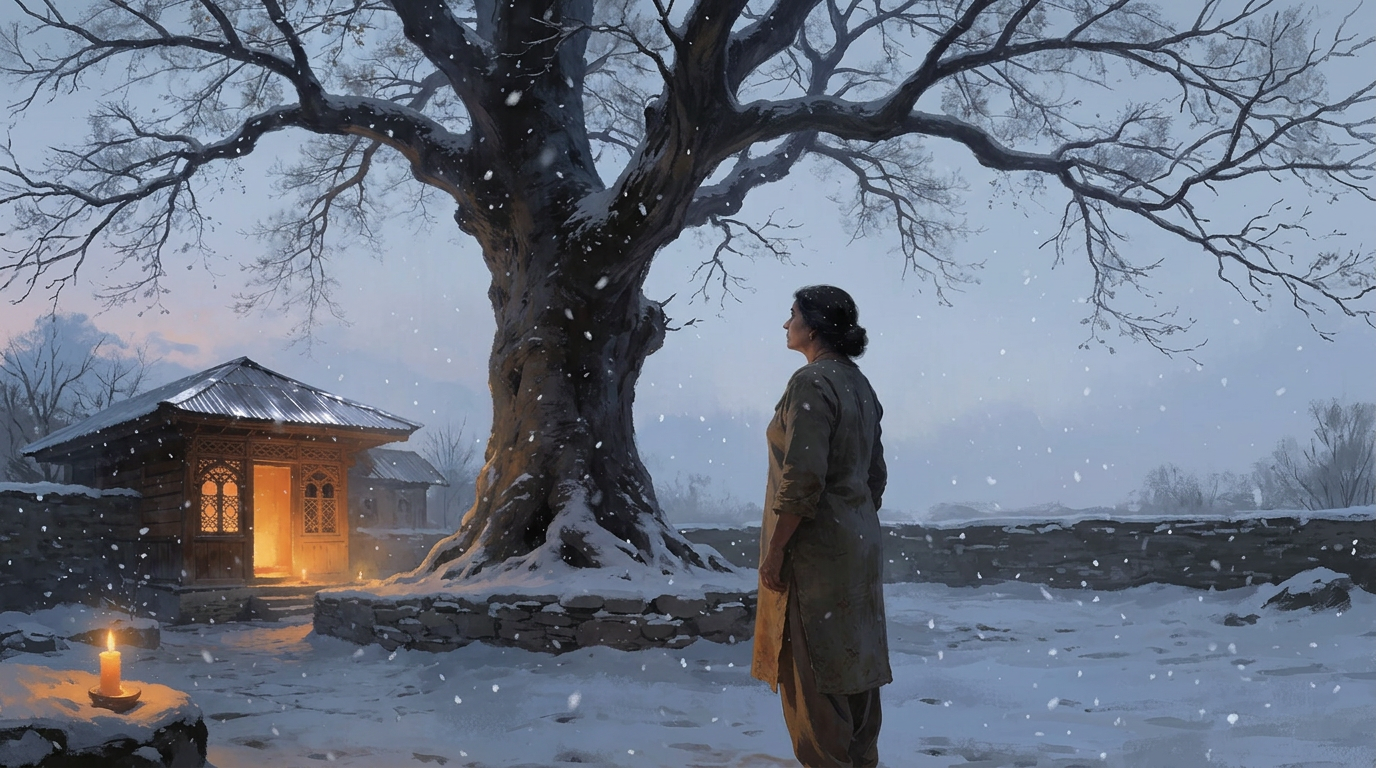
Their home was modest yet full of warmth. A small wooden house with sloping tin roofs, carved windows, and a courtyard where a proud chinar tree spread its branches like a protective guardian. In spring, almond blossoms filled the air with fragrance, and the sound of temple bells from a nearby shrine mingled with the gentle murmur of the river flowing not far away.
This was the house of Pandit Krishen Lal Koul, a respected school teacher known for his integrity and simple living. His wife, Shanta Koul, was the quiet strength of the household. She believed deeply in the values that defined Kashmiri Pandit culture: education, humility, dignity, and devotion. But the real pillar of the household, though no one recognised it then, was their eldest daughter, Nirmala.
A Daughter’s Quiet Devotion
From childhood, Nirmala possessed a maturity far beyond her years. While other children played carefree games in the courtyard, she often stood beside her mother in the kitchen, learning the rhythm of life that defined Kashmiri households. The aroma of haakh simmering in earthen pots, the careful preparation of nadru dishes during festivals, and the elaborate rituals during Herath, the great festival of Shiva, were all lessons she absorbed not merely as traditions but as responsibilities.
The Koul household was like many others in the valley, rich in culture but modest in wealth. Pandit Krishen Lal believed education was the greatest inheritance he could give his children. His son Ravi and younger daughter Meera attended school regularly, carrying their books with dreams of brighter futures. But destiny often chooses its own path.
One harsh winter, when the valley lay wrapped in thick snow and icy winds swept across rooftops, Pandit Krishen Lal fell gravely ill. What began as a minor illness slowly turned into a long struggle that drained the family’s savings and shattered their sense of security. Suddenly, the household that once stood firmly began to tremble under the weight of uncertainty.
It was during this time that Nirmala quietly stepped forward.
She abandoned her own ambitions of higher education and began tutoring neighbourhood children to support the family. It was not a decision she announced dramatically. It was simply something she did. Every morning she woke before dawn, completed household chores, prepared meals, and then spent long hours teaching children to earn a modest income. Her sacrifices slowly became invisible routines.
The Silent Architect
Years passed. Her brother Ravi completed his studies and eventually secured a respectable job in a government office. Her younger sister Meera was married with dignity into a respectable family. Relatives praised the family’s achievements during gatherings. But rarely did anyone pause to acknowledge the silent architect behind these successes.
Nirmala.
By the time these responsibilities were fulfilled, her youth had quietly slipped away. Marriage proposals had come and gone. Sometimes circumstances prevented them. Sometimes financial realities stood in the way. And sometimes society simply assumed that daughters who carried family burdens were destined to remain where they were.
Yet Nirmala never complained.
The valley itself seemed to mirror her quiet endurance. Seasons changed, snow melted into spring streams, saffron fields bloomed in distant villages, and life moved forward. But beneath this rhythm of normalcy, darker winds had begun to stir. Rumours spread through the valley. Fear whispered through neighbourhoods. The political turmoil that had been simmering beneath the surface began to erupt into open hostility. For the Kashmiri Pandit community, the nights of uncertainty grew longer.
Then came the winter that would change everything.
The Winter of 1990
One night, the silence of the valley was shattered by distant slogans echoing through the cold air. Families gathered inside their homes, whispering in fear. Doors were bolted. Lights were dimmed. And a terrible realisation slowly dawned upon thousands of Kashmiri Pandit families. The land they had called home for centuries was no longer safe.
Within days, the exodus began. Cars, trucks, buses, anything that could move, carried frightened families away from the valley. The Koul family too joined that tragic migration. Leaving behind their home, their memories, their ancestors’ land.
Nirmala stood at the courtyard gate one last time before leaving. Her eyes rested on the chinar tree beneath which she had spent her childhood. Snowflakes fell silently around her, as if the valley itself was mourning. Then she turned away.
Life in Exile
Like thousands of others, the Kouls arrived in Jammu, where refugee camps and temporary shelters became their new reality. Life in exile was harsh. Small, cramped rooms replaced spacious homes. Summer heat replaced the cool breeze of the valley. Dignity struggled against poverty.
But once again, Nirmala became the family’s pillar. She began teaching at a small school established for displaced children. Those children, many traumatised by sudden displacement, found comfort in her kindness. Through teaching, she discovered a new purpose.
Years passed. The family slowly rebuilt their lives. Ravi prospered in his career. Meera’s family flourished. But somewhere along the way, a painful distance began to grow between Nirmala and those she had sacrificed everything for. When matters of property and financial independence arose, the brother she had supported through life began to view her not as a benefactor but as a burden.
Words were spoken one day that pierced her heart deeper than any hardship she had ever endured.
You have lived with us long enough. Now you must think of your own arrangements.”
The sentence was simple. But behind it lay a painful betrayal.
A Room of Her Own
That night, Nirmala sat alone in silence. Memories flooded her mind. Years of sacrifice. Dreams she had set aside. Youth she had quietly given away. Yet she felt no anger. Only a deep sadness.
The next morning, she packed a small suitcase and left. Without bitterness. Without argument. She rented a small room near the school where she worked and began living independently. In that modest room filled with books and sunlight, she finally discovered a kind of peace she had never known. Her students became her family. Her life gained a quiet dignity that no betrayal could take away.
Years later, Ravi came to visit her. Time had humbled him. Age had softened his pride. Standing before the sister who had once been his silent protector, he struggled to speak. Tears finally replaced words.
Nirmala simply smiled. Forgiveness flowed from her heart as naturally as the river that once flowed near their childhood home. For she had long understood a truth that many learn too late. True sacrifice does not demand recognition. It simply becomes a light that continues to shine. Even when those who benefit from it forget its source.
Nirmala lived the rest of her life surrounded by the gratitude of thousands of students she had taught. Her story spread quietly through the community. People began to speak about daughters with new respect. And somewhere within society, a long overdue realisation slowly emerged: daughters are not burdens. They are the silent pillars upon which families stand.
Closing Reflection
The story of Nirmala is not merely the story of one woman. It is the story of countless daughters within our community. Daughters who sacrifice dreams, daughters who rebuild families after tragedy, daughters who prove through their courage that strength does not always roar. Sometimes it simply endures with grace.
As these final words are placed upon the page, my heart carries a deep sense of responsibility.
This story has not been written merely to narrate events, it has been written to awaken our collective conscience. Within our Kashmiri Pandit community, and indeed within every society, there are daughters whose sacrifices remain unspoken. Their struggles rarely appear in history books, their endurance often goes unnoticed, yet their contributions form the invisible foundation upon which families and communities survive.
If this humble narrative encourages even a few families to value their daughters more deeply, then its purpose will have been fulfilled. No sacrifice made by our daughters should ever go to waste. Let this message travel beyond these pages and settle in our hearts.
-With humility and devotion.







POST COMMENT