Panzath is a village situated at the northwest of the Shahabad Pargana 4 km to the east of Qazigund Town. Kashmir is the home to variety of springs and fresh-water bodies. One such spring, the most important in South Kashmir, is Panzath Nag. The spring is also called Nagbal by the locals and gives the Panzath village its name.
Panzath is derived from the Kashmiri word 'Paanch Hath'which means five hundred. This spring is the source for five hundred springs many of which are visible while others are hidden under it and its adjoining areas.
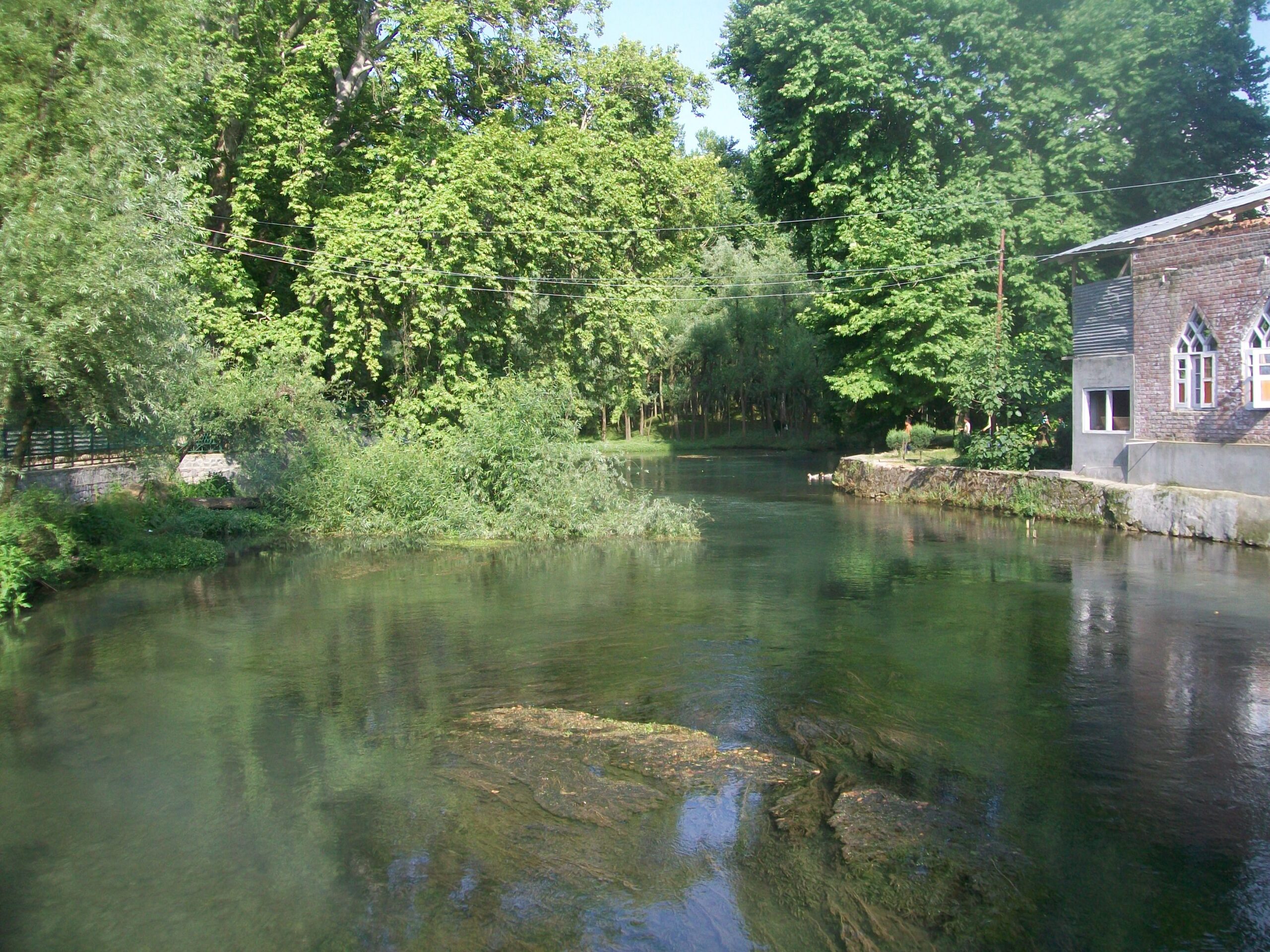
Nagbal spring is very deep with a huge quantity of crystal clear water gushing out from the north side of the spring. The water of this spring is so clear that one can see rocks and weeds at the bottom, and there is a tradition of a boatman, an experienced swimmer, having have dived into it, and never having risen again. Close to it is another spring; and near it, in the open plain, is an accidental mass of shingly conglomerate, 6 to 7 feet thick, which appears to have been rolled there by some extraordinary force, rather than to be the remnant of a large bed deposited on the spot, as no formation of the kind is known to exist within a considerable distance of it. A canal formed for the purpose of irrigation conveys the waters of Nagbal over the Beyhama Khrewa to a junction with the Sandrine River.
This old locality Pancahasta, is that the site of one of the normal sources of the Vitasta. Kalhana mentions it in connection with a Math which Suravarman, Avantivarman’s minister, built here. A pretty valley that opens to the south of Panzath is now known by the name of its chief village Ruzul. The latter is mentioned by Jonaraja as Rajolaka. About 7 km higher up this valley is the Naga of Vasuki. It is mentioned in the Nilamata and other old texts but does not appear to have ever been an important pilgrimage centre.
An ancient legend, related at length within the Nilamata Purana (Verse: 238) and reproduced by the authors of the Haracaritacintamani, represents the Vitasta as a manifestation of Siva’s consort Parvati. After Kashmir had been created by Sage Kashyapa, Siva at the request of Kashyapa prevailed upon the goddess to show herself in the land in the shape of a river, so on purify its inhabitants from the sinful contact with the Pisacas. The goddess thereupon assumed the shape of a river within the underworld and asked her consort to form a gap by which she might come to the surface. This he did by striking the bottom near the habitation of the Nilanaga with the purpose of his trident. Through the fissure thus made which measured one Vitasti or span, the river gushed forth, receiving on account of this origin the name Vitasta. The spring basin where the goddess first appeared was known by the several destinations of Nilakunda, Sulaghata (spear-thrust) or simply Vitasta.
It is clear that the spring meant is the famous Nilanaga, near the village of Verinag. It is a magnificent fountain that amply deserves the honour of being thus represented as the traditional source of the great river.
The water of this spring is so clear that one can see rocks and weeds at the bottom.
The legend makes Goddess Parvati…Vitasta subsequently disappears again from fear of defilement by the touch of a sinful man. When brought to light a second time Kashyapa’s prayer the goddess issued from the Naga of Pancahasta, the present Panzath and boasting of a fine spring which was visited by the pious man of the neighbourhood. After another disappearance for a reason almost like the rationale mentioned above, the goddess came forth a third time at Narasimhasrama and eventually the goddess was induced to abide permanently in the land when Kashyapa had secured for her the company of other goddesses, who also embodied themselves in Kashmir streams, like Laksmi in the Visoka (Vashav), Ganga in the Sindhu, etc.
Another version of the legend which, however, seems of less ancient date, seeks the place of the Vitasta’s second appearance in the spring of the Vyetha Vuthur, a small village situated about three miles to the northwest of Verinag. This place is known by the name of Vitastatra to Kalhana who mentions stupas erected there by King Ashoka.
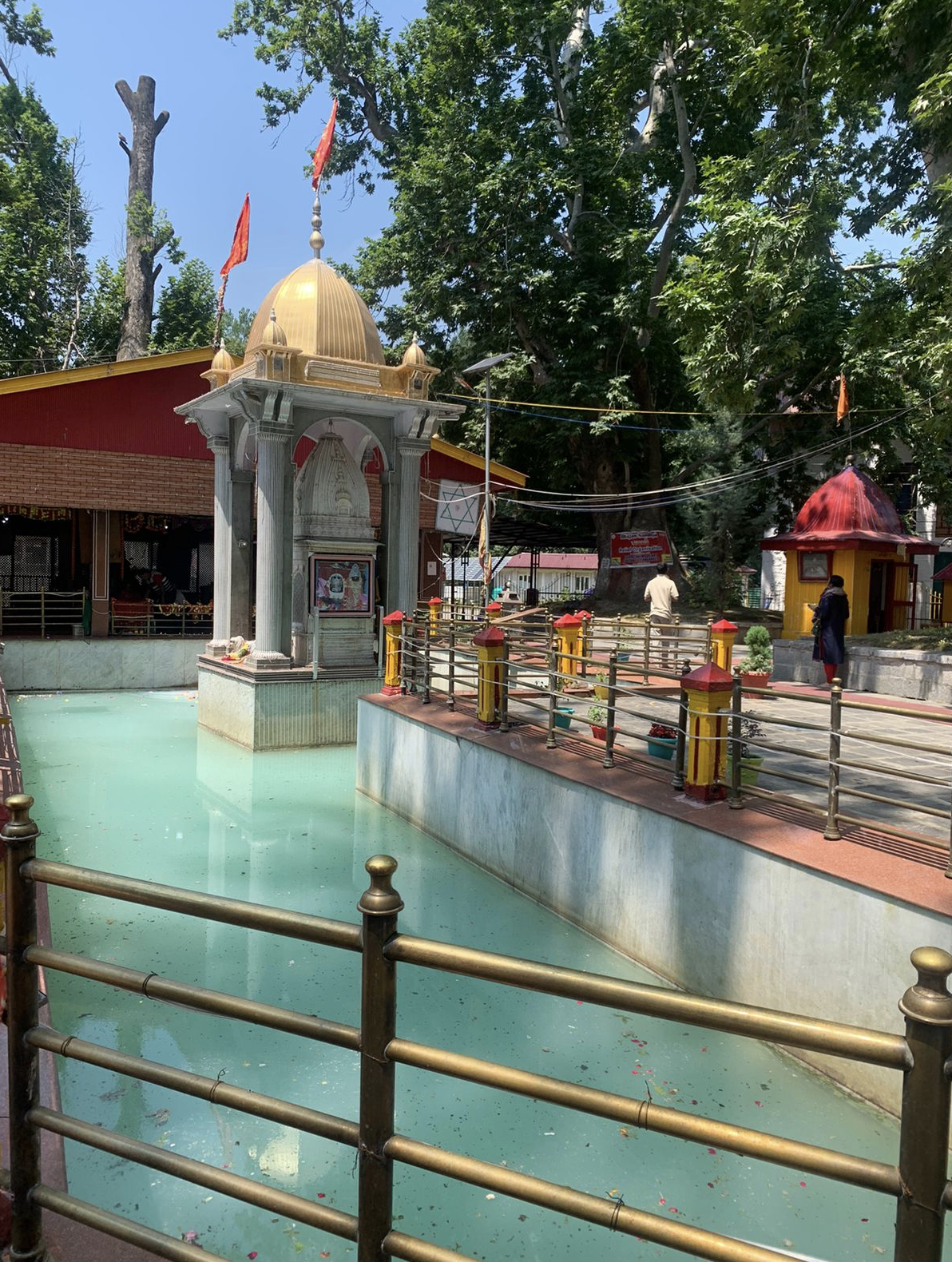
There was a huge Shiv Lingam on the eastern side of Nagbal partly submerged in water and the same Lingam disappeared under mysterious circumstances in the year 1978.
The area attached with this spring spread over an area of about 9 Kanal of land with lust green meadows. Three big Chinar trees on western side and four Chinar trees on the eastern side add to the grandeur of this area.
The spring abounds with fish. There is a legend that the Spring Goddess (Nag Moej in Kashmiri) after visiting Panzath Nag asked his son to give her a proper place to live in and the son, a Nag disrespectfully denied her. The spring Goddess cursed him with a boon that the fish of the eastern side will have only one eye and even this day the fish of the eastern side of this spring is having only one eye.
There is a marshy land (Sar in Kashmiri) ahead of Nagbal towards Pahkot Hill. Pandits from neighbouring villages used to collect “Vai” (Acorus Calamus) which was used by the Pandit community day before “Sounth” and “Navreh” for placing the same on the traditional “Thaal Barun” to possess the primary glimpse on the morning of “Sounth” and “Navreh”.
At the base of the Pahkot Hill ahead of marshy land there are some icons believed to be Sapt Rashi and are smeared with vermilion. Pandits from Levdora, Taragam, Qazigund, Korigam, Yourkshipora, and Chowgam villages used to visit this place especially on the third day of Navreh (known as Zangi Tri) and perform puja. Pandit Neilkant Pandita and Pandit Vaishnov Muqdam (who was a saintly person) from village Levdora were the daily visitors to this shrine. Both of them used to visit this place in the wee hours and after having a bath at Nagbal used to perform puja at Sapt Rashi. Shri Maharaj Krishan Pandita son of Pandit Neilkanth Pandita resident of village Levdora disclosed that a barat of a Hindu family got buried rather than disappeared at Panzath Nag some 80 years back.
Kashmiri Pandits in large numbers from the adjoining villages used to celebrate Navreh and Zangi Tri on the bank of Nagbal.








POST COMMENT