The Vanishing of Kashinath Dhar Sanyasi
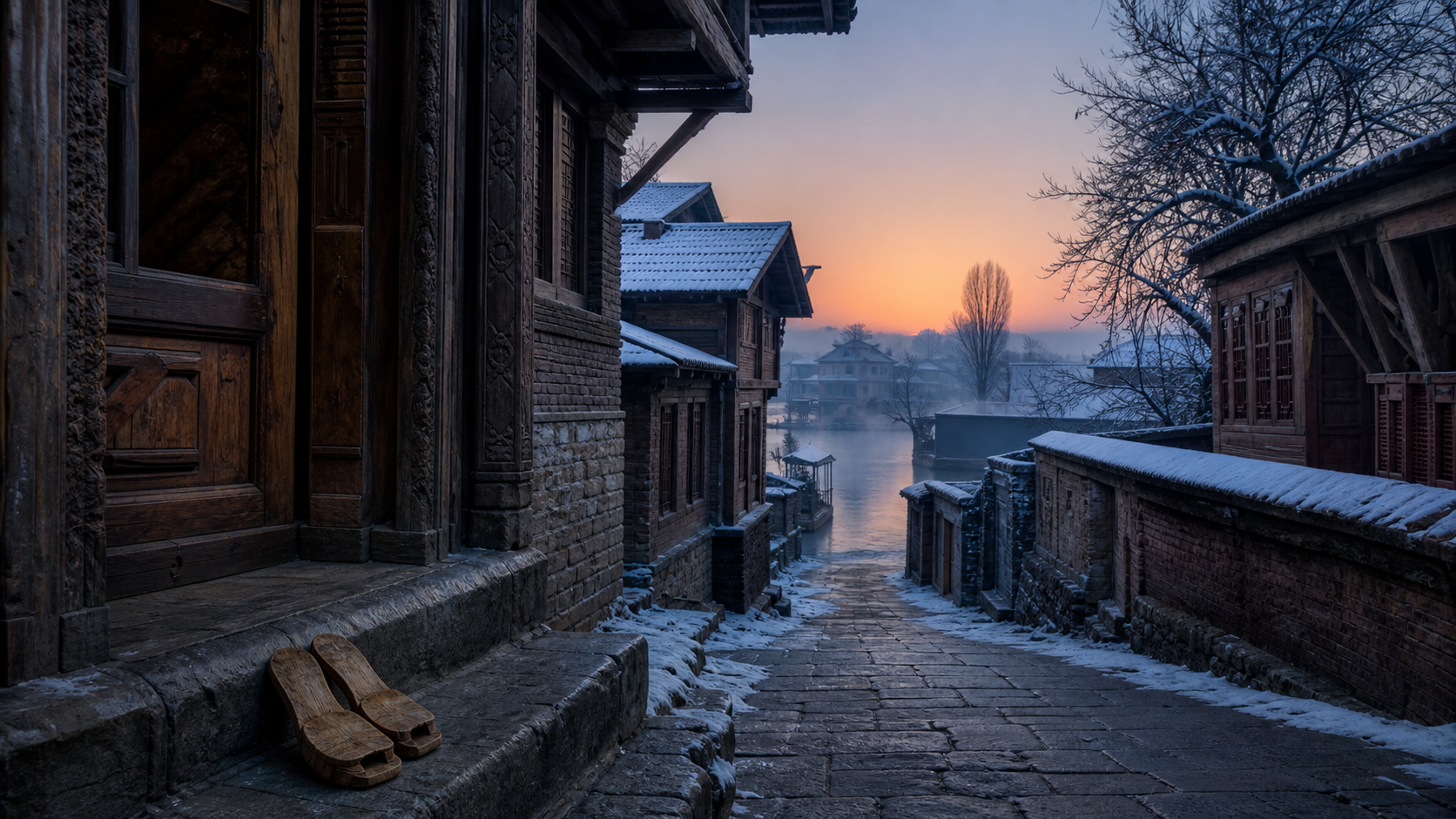
In the old historical areas of Habba Kadal, where the wooden bridges sighed under centuries of footsteps and the Jhelum River flowed like memory itself, stood the ancient locality of Malyar.
Its narrow lanes, kochas, galis as we call them, carried the fragrance of morning kahwa chai, temple bells, old Kashmiri bhajans, leelas, Sanskrit verses, and whispered stories of saints who once walked barefoot upon its stones.
Among its children was born an unusual boy, Kashinath Dhar.
From the very beginning, people knew he was not like the others.
While boys his age chased spinning wheels, ran cycle tubes along roads with a stick, and played cricket in the alleys, Kashinath would sit for hours beside the temple steps of Maha Ganpat’s Dwar, the Ganpatyar temple, and Somyar, gazing silently at the river as if truly listening to voices hidden beneath its currents.
Teachers found him brilliant beyond measure, yet strangely detached. He spoke softly, but every sentence carried weight.
Even as a young student, he questioned not the world outside, but the world within.
“Why does man seek what he must leave behind?” he once asked his Sanskrit teacher.
The old teacher remained silent.
Years passed, and Kashinath became known among the Kashmiri Pandit community as a rare scholar, a Gyani Upadeshak, deeply immersed in the profound streams of Kashmir Shaivism.
He could speak for hours on Abhinavagupta, other Kashmiri scholar saints and Mahapurshas, on Shiva and Shakti, yet his words never sounded like lectures.
They flowed like the Jhelum itself, calm, compassionate, luminous.
People came to hear him not merely for knowledge, but for peace.
His discourses carried sweetness.
Even disagreement dissolved in his presence. The old saw wisdom in him. The young saw clarity. The broken found comfort in his silence.
But Kashinath himself owned almost nothing.
He lived in a modest room lined only with books, a pheran, a blanket, a woolen shawl, a copper lota, and an earthen lamp.
People offered him money, costly shawls, gold ornaments, even land after his lectures. He accepted none of it.
Once, a wealthy trader from Sopore placed before him a pouch of gold coins.
“Maharaj,” the man said, “please accept this for your service to Dharma.”
Kashinath smiled gently…
He lifted one coin, looked at it quietly, and then placed it upon the dusty floor beside his feet.
“Gold,” he whispered, “is only sunlight that forgot its source.”
The trader stood confused. Kashinath continued,
“A sanyasi does not fear wealth because wealth is evil. He avoids it because attachment is subtle. Gold enters not the pocket first. It enters the mind.”
Those around him never forgot those words.
The Necklace of Karma
There was another story people often repeated about him.
One winter evening, during a cremation in Karan Nagar, Srinagar, near the banks of the river, someone discovered a diamond necklace hidden within the garments of a deceased noblewoman. Panic spread among the attendants. Some wished to keep it secretly.
One man approached Kashinath.
“Maharaj,” he said, “if this wealth is used for temple service, surely it becomes holy?”
Kashinath’s eyes darkened with compassion.
“No,” he replied. “That which comes through hidden greed carries hidden sorrow.”
Then he uttered words that later became famous among his disciples:
“Every object carries the fingerprints of karma.
A seeker who lifts unnecessary wealth also lifts unseen debts.”
The necklace was returned to the family.
From that day onward, people began calling him not merely a scholar, but a living yogi.
The Night of Departure from the Valley
Then came the dark years. The winter of fear.
The crackling loudspeakers. The trembling nights of January 1990.
The exodus of Kashmiri Pandits from the Valley in 1990 became not merely a migration, but the tearing apart of memory itself.
Families fled with keys in their pockets and tears frozen upon their faces.
Kashinath Dhar watched silently as homes emptied, temples closed, and neighbors vanished overnight.
Yet something changed within him after those days.
Those close to him noticed he spoke less and meditated more. He would disappear for days into the forests near Harwan or into mountain shrines beyond the city.
His eyes carried both grief and detachment, as if he had witnessed something deeper than worldly tragedy.
One evening, shortly before the heavy snows of December 1995, he gathered a few disciples. The oil lamp flickered softly. He spoke very little.
“The soul,” he said quietly, “must sometimes disappear from the noise so that Truth may continue breathing.”
One disciple began to cry.
“Guruji, where will you go?”
Kashinath smiled faintly. “Where silence is still alive.”
The very next morning, he was gone.
No farewell. No possessions. No trace.
Only his worn wooden sandals remained outside the room.
Rumours in the Himalayas
Years turned into decades.
Some claimed they had seen him near the caves of Amarnath, seated among wandering ascetics during snowfall.
Others whispered that a silent yogi resembling him meditated in remote Himalayan regions beyond the Kailash Range.
A pilgrim once claimed that an old saint stopped him during a storm and said, “Kashmir shall return first in spirit, then in land.”
Before the pilgrim could ask more, the saint vanished into the mist.
No one knows if the story was true.
His disciples dispersed quietly. Some became teachers. Some entered ordinary life. Some continued silent practices without ever speaking publicly of him again.
Perhaps that too was his instruction.
Why Did He Disappear?
People often ask, why would such a saintly man choose obscurity over fame?
The answer perhaps lies in the very essence of Sanyasa.
A true ascetic does not seek followers, institutions, or public glory. Publicity creates identity, and identity becomes bondage. Saints like Kashinath Dhar understood that spiritual power weakens when it becomes performance. He knew the danger of being worshipped rather than understood.
The world today often celebrates loud spirituality, grand stages, fame, wealth, organized empires in the name of religion. But some rare souls walk the opposite path. They disappear to protect the purity of their inner flame.
Perhaps Kashinath Dhar realized that the Valley itself had entered a karmic twilight, a period of collective suffering where silence was holier than speeches. Or perhaps he withdrew because grief had grown too deep for words.
There are yogis in Indian tradition who vanish deliberately into anonymity. It is believed that some saints continue to guide humanity invisibly, through prayer, meditation, and spiritual vibration rather than physical presence.
Maybe he became one among them.
Will He Return?
No one can answer with certainty.
Some elders believe that if he still lives, he will emerge only when Kashmir regains not merely political calm, but spiritual balance, when fear decreases, when hearts soften again, when communities remember coexistence rather than wounds.
Others believe he may never return physically at all. For saints, disappearance is not always absence. Sometimes they become part of the unseen conscience of a civilization.
And what of Kashmir itself?
Will the exiled return to their homeland fully once again?
History moves slowly, but memory moves eternally.
The chinars still stand. The temples still wait. The rivers still remember the footsteps of those who left.
Perhaps return will happen first within hearts, when bitterness gives way to healing, when memory stops bleeding and begins blessing.
Maybe then, one winter dawn, an old saffron-clad figure with snow upon his shoulders may quietly walk again through the lanes of Malyar, Habbakadal.
Perhaps someone will recognize the gentle eyes.
Or perhaps he will pass unnoticed, smiling softly, untouched by the world he had already renounced long ago.
For who truly knows the journeys of saints?
And who can measure the timing of God?
May we all bow at the lotus feet of saints like Jagat Guru Bhagwan Gopinath Ji Maharaj and seek His divine blessings always.









POST COMMENT