A Story from the Red Lights of Gandhi Nagar Morh and Satwari Chowk, Jammu
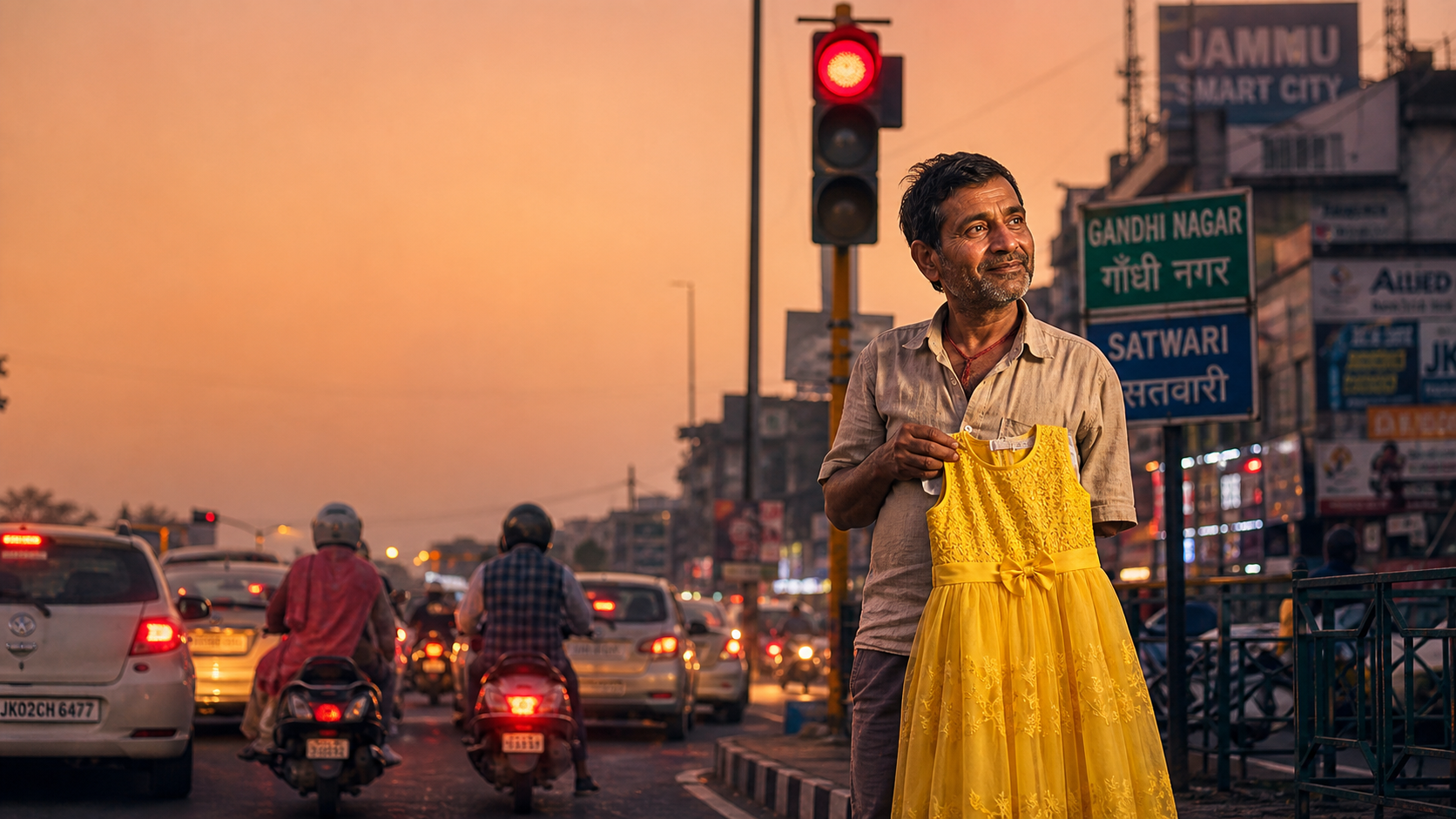
In the crowded heart of Jammu city, where vehicles roar endlessly through the crossings of Jewel Chowk, Gandhi Nagar, and Satwari Chowk, thousands of people pass each other every day without ever truly seeing one another.
Cars stop at red lights. Vendors rush between vehicles. Beggars stretch trembling hands toward tinted windows. Some faces are ignored. Some are insulted. Some disappear into the noise forever.
But among those forgotten faces once stood a man whom people today lovingly call “Raju Uncle.”
Few know the storms hidden behind his gentle smile.
Today, on the third floor of an aging apartment building near Rampur, Nai Basti Last Morh, Gandhi Nagar, Jammu, lives a small family whose evenings are filled with warmth.
The modest one-room flat, though ramshackle in appearance, has faded cream walls, an old rusted cooler humming in summer, a few steel utensils, and a large earthen matka filled with drinking water—its mouth covered neatly with an upturned glass. Framed photographs of family members are carefully arranged above a wooden shelf.
One photograph stands apart. A little girl in a bright yellow frock, smiling with innocent pride. Whenever visitors ask about it, Raju grows silent.
Because that photograph carries the entire history of his life.
The Journey from Nowshera…
Raju was not born in Jammu city. He belonged to a small village near Nowshera, where life moved slowly among dusty lanes, wheat fields, and the distant sound of temple bells carried by evening winds.
His father, Ramkishen, was a hardworking but poor man who owned almost nothing except honesty. The family survived on odd labour work and seasonal farming. During difficult years, even food became uncertain.
In 1979, when Raju was barely eight years old, Ramkishen made the painful decision to move to Jammu in search of livelihood.
They arrived with two steel trunks, a few blankets, and dreams larger than their circumstances. Jammu was expanding rapidly then—construction sites, transport depots, roadside markets, and labour chowks offered survival to those willing to work endlessly.
Ramkishen rented a tiny single-room space near old Satwari. The roof leaked during rain. Summers were unbearable. Winters cut through the walls like knives.
But to young Raju, the city still felt magical.
At night, he watched buses arrive from distant states and imagined that one day he too would become successful enough to give his parents a peaceful life.
Ramkishen often told him, “Beta, poverty is painful, but never lose your dignity. A poor man may sleep hungry, but he should never sleep dishonestly.”
Those words buried themselves deep inside Raju’s soul.
The Boy Who Became a Man Too Early
Childhood ended early.
Before sunrise, he delivered milk packets. After school, he worked at tea stalls, transport godowns, and mechanic shops.
By sixteen, he had become strong, dependable, and mature beyond his years. Eventually, he found work as a helper with a private transport company near the Jammu bus stand. The salary was small, but he worked sincerely.
Life slowly improved…
And then destiny brought someone into his life.
Shanta — The Woman with Quiet Strength
Her name was Shanta.
She lived with her widowed mother near Gandhi Nagar, stitching clothes and teaching children to support the household.
She was not highly educated, nor fashionable.
But she possessed something rare—grace in hardship.
Raju first noticed her during a temple gathering, where she served prasad to elderly women before taking any for herself.
Their conversations began simply—greetings, shared walks, roadside tea.
Shanta admired that Raju never complained despite poverty.
And Raju saw in her the calm strength of a true companion.
When they married, they owned almost nothing—a steel bed, two chairs, a borrowed stove, and endless hope.
Yet those years became the richest phase of their lives.
Their Little World…
Soon their daughter was born—Reema.
Two years later came little Chotu, whose real name was Mohan.
Their small rented room near Satwari became a universe of laughter. Sundays were celebrations.
Raju brought samosas and jalebis wrapped in newspaper. On special days, Shanta cooked rajma-chawal while the children fought over the extra spoon of ghee.
During power cuts, they sat on the rooftop under open skies.
Reema asked endless questions about stars.
Chotu floated paper boats in rainwater drains, laughing uncontrollably.
They were poor days.
But they were beautiful.
The Night of Destruction…
Then came the rainstorm that destroyed everything.
One evening, while returning from work in an overcrowded bus, the driver lost control near a flooded crossing. The crash was violent. Metal twisted. Glass shattered. Screams filled the darkness.
When Raju regained consciousness in the hospital, Shanta sat beside him, her eyes swollen from crying.
His right arm was gone.
He stared at the empty space beside him.
Then turned his face to the wall and wept silently—not from pain, but from the knowledge that his family’s future had collapsed.
The Slow Death of Dignity…
After recovery came rejection.
Employers turned him away. Some spoke kindly. Others mocked him.
“How will you work with one hand?”
“Who will hire you?”
Savings vanished. Rent piled up. Medicines became unaffordable.
Shanta stitched day and night, but it was never enough.
Hunger entered quietly. First milk was reduced. Then vegetables. Then meals.
One evening, Reema asked, “Maa, why are you not hungry every night?”
Shanta smiled, “Because mothers become full by feeding their children.”
That night, she cried silently.
The First Day at the Red Light…
With no options left, one morning Raju walked to the red light at Gandhi Nagar Morh.
The signal turned red. Cars lined up.
And there stood Raju—trembling, broken, unable to raise his eyes.
The first hand he stretched felt heavier than stone.
Some ignored him. Some stared coldly. One man rolled up his window angrily, as if Raju himself were a disease.
When the signal turned green, vehicles rushed away, leaving behind smoke and humiliation.
That evening, he returned home with a few coins.
He could not meet Shanta’s eyes.
But she simply said, “A wound does not make a man smaller. Giving up does.”
The Yellow Dress…
Near Gandhi Nagar market stood a clothing shop displaying bright dresses.
Every day, Reema paused to look at a yellow frock. Never asking—only looking.
One day she whispered, “Papa… one day I will wear such a dress.”
That became his reason to survive.
For two years, Raju saved coins from begging. Sometimes he skipped meals. Sometimes he drank only water. But he never touched those savings.
Finally, one winter evening, he entered the shop with Reema.
He placed crumpled notes on the counter.
The shopkeeper frowned. “Where did you collect all this from? Are you a beggar?”
Reema lowered her eyes. “Papa, let’s go.”
But Raju gently wiped her tears and said,
“Yes… I beg. But today I have come as a father.”
Silence filled the shop.
The yellow dress was handed over.
That evening, for the first time in years, Raju felt richer than everyone else there.
A Turn in Fate
Years passed at the signals. Raju witnessed the darker side of begging—organized rackets, exploitation, and forced suffering.
Then one day, a retired teacher, Mrs. Mehta, noticed him.
She saw his dignity.
“If given work, will you do it?” she asked.
“Even if I must clean floors with one hand,” he replied.
Soon, he became a night caretaker.
It changed everything.
Rebuilding Life
Slowly, the family stood again.
Shanta expanded her tailoring work.
Reema studied and began teaching.
Chotu learned mobile repair.
They moved into a small apartment.
Respect returned.
The Signals Still Remain…
Even today, when Raju passes those red lights, his eyes grow distant.
He remembers hunger. Humiliation. Rain-soaked pavements.
But he also remembers compassion.
One act of kindness changed everything.
The Larger Truth…
Poverty cannot be solved by punishment or casual charity.
It requires rehabilitation, accountability, and opportunity.
We must act against organized exploitation, while supporting those who genuinely suffer—with skills, education, healthcare, and dignity.
Because not every beggar lacks ability.
Sometimes life simply crushes people before society notices.
The Last Scene…
One evening, children gathered around Raju Uncle for stories.
He quietly brought out the preserved yellow dress.
Its color had faded.
Its meaning had not.
Reema smiled through tears.
Shanta stood silently beside them.
And Raju looked toward the distant red lights of Jammu.
Once, they witnessed his defeat.
Today, they remind him of dignity regained.
For poverty may wound a man…
But compassion can restore his humanity.








POST COMMENT