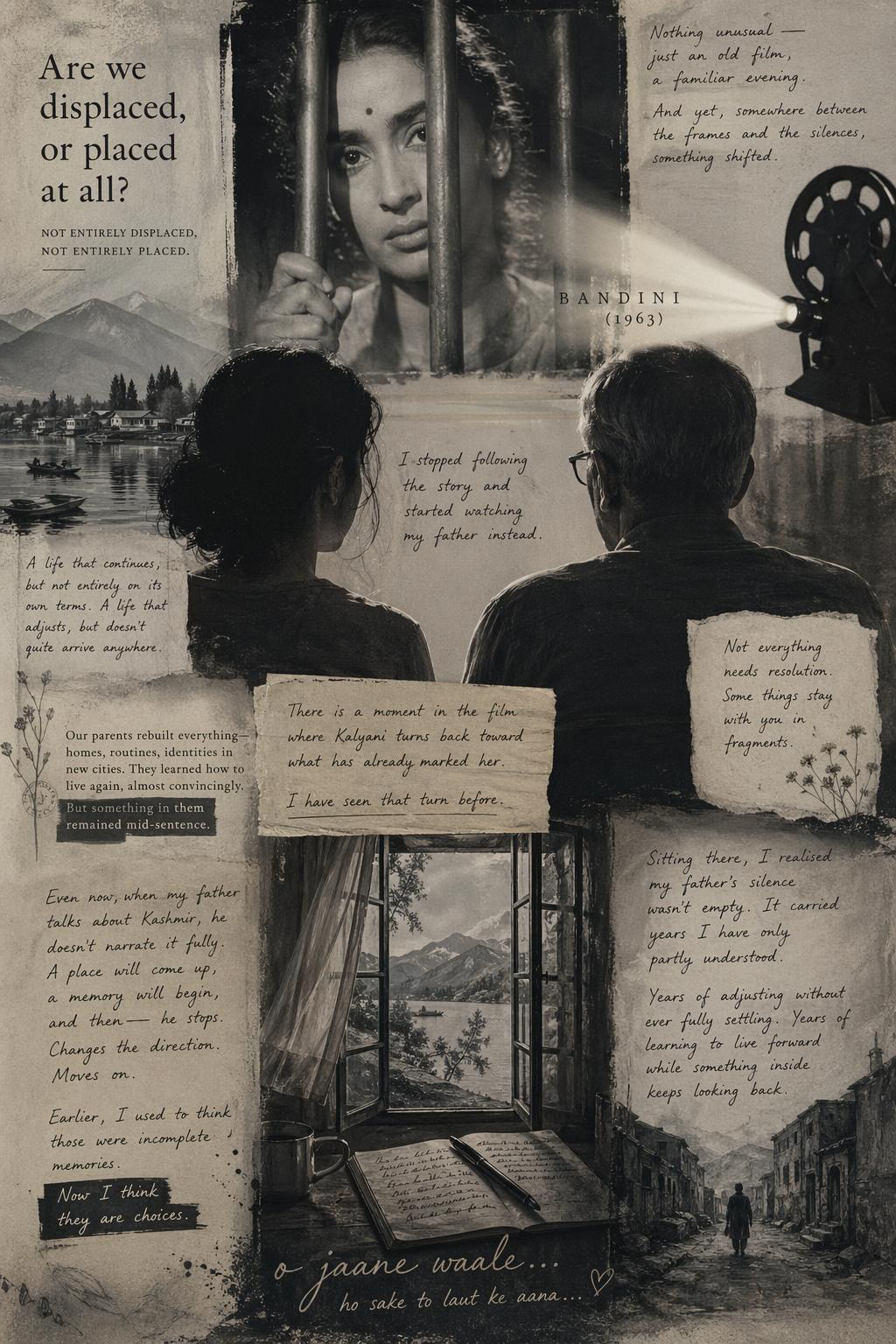
Yesterday, I was watching Bandini with my father.
Nothing unusual… just an old film, a familiar evening. And yet, somewhere between the grain of black-and-white frames… and the silences that lingered a little longer than usual, something moved within.
Beside me, my father sat very still. Not absorbed in the usual way, not reacting, not commenting. Just… there. As if he wasn’t watching the film as much as sitting inside it.
There is something about the way Nutan holds Kalyani. She doesn’t ask for sympathy. She doesn’t explain. Even her quietness feels occupied, as if they have a history of their own.
At one point, I stopped following the story and started watching my father instead.
I kept wondering… what part of this is he seeing?
What part is he not saying?
Because exile has a way of doing that. It doesn’t always speak directly. It settles somewhere between words, in the entr’acte, in what gets left unfinished.
Kalyani is in prison, but it never felt like the film was only about prison. It felt closer to something else. A life that continues, but not entirely on its own terms. A life that adjusts, but doesn’t arrive anywhere.
That felt familiar in a way I couldn’t ignore.
As Kashmiri Pandits, we have grown up around that same kind of continuation. Our parents rebuilt everything… homes, routines, identities in new cities. They learned how to live again, almost convincingly. But something in them remained mid-sentence.
Even now, when my father talks about Kashmir, he doesn’t narrate it fully. A place will come up, a memory will begin, and then… he stops. Changes the direction. Moves on.
Earlier, I used to think those were incomplete memories.
Now I think they are choices.
Those stretches of Kalyani’s don’t feel like gaps at all. They feel chosen. As if she knows exactly where to stop, what to hold back, what cannot be said without disturbing everything that still manages to stand.
There is a moment in the film where Kalyani is offered a different life. A softer one. A way out that looks almost generous. And yet, she turns back toward what has already marked her.
I felt something tighten when that happened.
Because I have seen that turn before.
In the way we hold on to things that others think we should have outgrown.
In the way “home” is still spoken of as if it hasn’t slipped into distance.
In the humble insistence of identity, of not letting it dissolve just to make things easier.
Is it about comfort? Is it about recognition? I don’t know.
Sitting there, I realised my father’s composure wasn’t empty. It carried years I have only partly understood. Years of adjusting without ever fully settling. Years of learning to live forward while something inside keeps looking back.
We, the middle-aged ones now, have inherited that rhythm.
I ask myself, “Are we displaced, or have we simply never quite arrived anywhere?”
We function, we build, we even belong in ways that look complete from the outside. But there is a loop somewhere. A point in time that didn’t move with the rest of the world and we keep circling it, knowingly or not.
The film ended. We didn’t discuss it much.
Just a small, passing remark. Something about how films were made differently then.
And that was it.
But the room didn’t feel the same anymore.
It felt like something had been acknowledged without being spoken.
Not everything needs resolution. Some things stay with you in fragments, and you learn how to carry them without arranging them into a neat ending.
Yesterday wasn’t about watching a film.
It felt like sitting beside a life I am still learning to read.
And somewhere, almost like an afterthought,
दे दे के ये आवाज़ कोई हर घड़ी बुलाए
फिर जाए जो उस पार कभी लौट के न आए
है भेद ये कैसा कोई कुछ तो बताना
ओ जानेवाले हो सके तो लौट के आना, ”
kept playing.. लong after the film had ended.








Anu Raina
Absolutely beautiful … !!