In October 1983, Kapil Dev’s India, the team that had just shocked the world at Lord’s, came to Kashmir. They played at Sher-e-Kashmir Stadium. I was very small. But I remember the electricity in the air, and I don’t mean the kind that came and went on its own mysterious schedule.
Cricket came to us differently back then. Not through fibre-optic cables or a phone screen glowing at midnight. It came through static. Through a small, battered transistor that sat on top of the almirah, the old wooden wardrobe, like a deity, half-broken and completely indispensable. I was too young to truly grasp what Kapil Dev had done at Lord’s that summer. But I was old enough to feel it in the room. In the way the adults stopped breathing. In the way my Mamaji’s hands gripped the transistor a little tighter, as if holding it steady could somehow hold India steady too. Mamaji, my mother’s older brother, known fondly as Bairaj, has always had a way of making everything feel like it mattered.
Even in those times, cricket in Kashmir wasn’t just a game. It was a conversation with God, conducted at high volume, with frequent interruptions from the electricity board.
The Match Kashmir Remembers
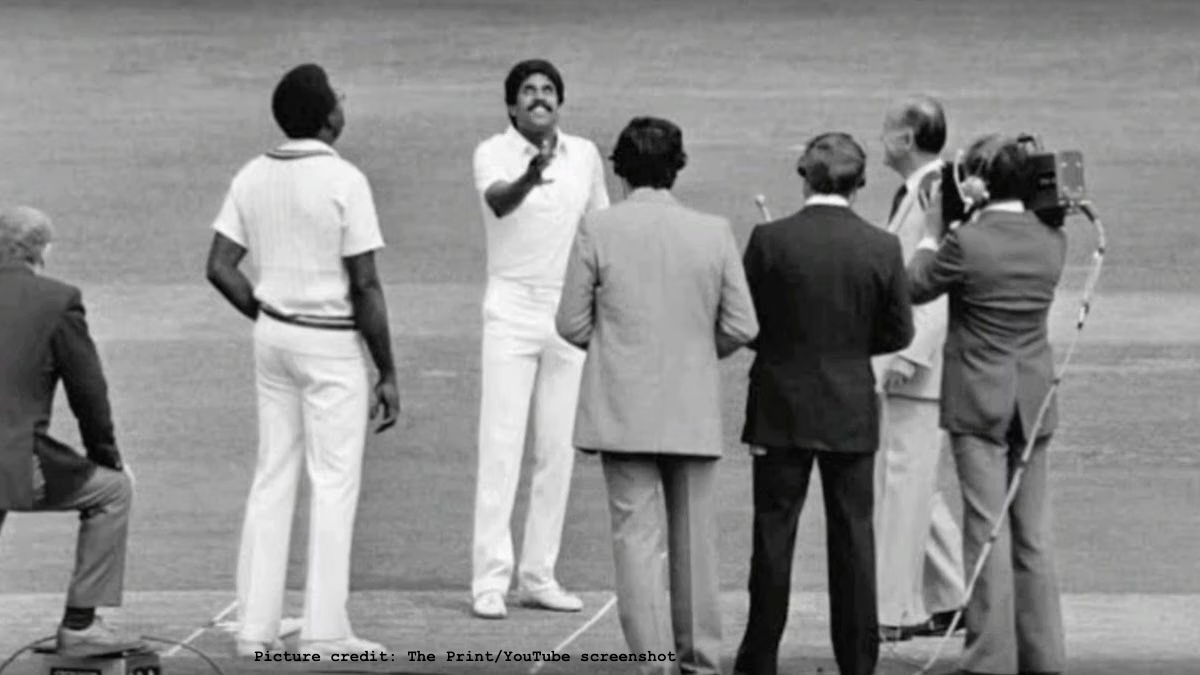
13th October 1983. Sher-e-Kashmir Stadium, Srinagar.
Close your eyes and think about what that fixture meant for a moment. The newly crowned World Champions, Kapil Dev’s India, still dizzy from that impossible summer at Lord’s, against the mighty West Indies, led by the imperious Clive Lloyd. Viv Richards, Gordon Greenidge, Desmond Haynes, Michael Holding, Malcolm Marshall and Andy Roberts on one side. Gavaskar, Vengsarkar, Srikanth, Sandeep Patil and Kapil Dev himself on the other. A cast more star-studded than most films could assemble. And it was happening here. In the valley. In Kashmir. In a stadium named after Sheikh Mohammad Abdullah, with mountains for a backdrop and winter already sharpening itself on the horizon. For a boy growing up on transistor static and borrowed glory, this was as close to a miracle as cricket could offer.
But what unfolded that day was not the celebration anyone, least of all Mamaji somewhere in those stands, had hoped for. The Windies won the toss and put India in on a cold, damp pitch. Almost immediately, something felt deeply wrong. A hostile section of the crowd began chanting Pakistan Zindabad. Posters of Imran Khan appeared in the stands. Every Indian wicket drew loud cheers. Every boundary was booed. India was bowled out for 176, Srikanth top-scoring with 40, batting through a wall of hostility rather than applause.
During the lunch break, men invaded the pitch and attempted to dig it up. When the West Indies came out to chase, bottles and stones rained down on the Indian fielders. Gavaskar, fielding near the boundary, was shown a giant poster of Imran Khan, the crowd determined to rattle every nerve. West Indies won the rain-curtailed match without losing a wicket. Captain Kapil Dev considered pulling the team off the field mid-match. He stayed. But the message from Srinagar had been sent, and it echoed far beyond any scorecard.
I have thought about Mamaji in that crowd many times. Rooting for India the way he always did, wrapped in his pheran, standing in a stadium that had long since stopped being just a stadium, caught between the game he loved and the valley that was already, quietly, beginning to change.
The Half-Light We Grew Up In
Most days, of course, we weren’t anywhere near a stadium. We were at home, in living rooms that held more shadows than light, waiting, always waiting, for the electricity to decide it was in a good mood.
Load shedding in Kashmir was not an inconvenience. It was a rhythm. Single phase. Double phase. The schedule that wasn’t really a schedule. Electricity arrived and disappeared unannounced. When the bulbs flickered on, the whole house mobilised: showers, ironing, charging the emergency light, racing the clock before the inevitable cut came again. We grew up expert in the choreography of urgency and patience.
But the transistor never left us. In a house where light was unreliable, sound was the one constant. Bobji, my grandfather, had understood this long before any of us. He would be up bright and early, while the rest of the household was still on snooze. Transistor pressed close, carefully tuning into the BBC World Service as if receiving dispatches from another world. His other favourite was Radio Ceylon, with Binaca Geetmala drifting in across the static. Bobji would sit with it all, perfectly still and content.
My father carried that same habit forward. He would tilt the radio towards the window, coaxing a signal, trying to catch commentary from a stadium a thousand miles away. Those voices would drift into our room and somehow make it larger. Suddenly we weren’t in a small house in Kashmir. We were at Eden Gardens, at Chepauk, at the Oval, breathing the same air as sixty thousand strangers.
And then there was Zoon Dab, that warm, familiar morning voice on Radio Kashmir. An eclectic mix of satire, folk music and gentle commentary on the absurdities of everyday life. It formed an essential part of the morning ritual while everyone was getting ready to get to work/school, laughing at jokes about the electricity board that hit a little too close to home.
Ceremonial Milk Spill
Mamaji is the kind of man people describe with quiet reverence, a straight line in a crooked world. Deeply sincere in a way that almost embarrasses modern cynicism. But put India batting in a tight chase in front of him, or let Lata Mangeshkar drift from a nearby radio, and something in that straight line gently curves. Something in him loosens and comes beautifully undone.
My mother speaks about her brothers and their love of cricket as though describing a force of nature. It did not matter whether it was an international, a Ranji Trophy clash or a scrappy gully match in the by-lanes outside; they were drawn to it like moths to a flame. On those rare occasions a match was played in Srinagar, they would turn up at the stadium wrapped in their warm pherans, the long traditional Kashmiri cloak. For matches played far afield, they would huddle around the transistor, leaning in as if getting closer to the box might somehow improve India’s batting. And when no commentary was available in the off-season, the lane itself would turn into their own Eden Gardens: a battered leather ball, a plank for a bat, a chalk mark on a wall for stumps. The game was everywhere they were, and they were everywhere the game was.
And then there is the story. The one I have heard so many times I can almost smell it.
Babi, my nani, my maternal grandmother, sends him out through the lanes of Drabiyaar with a small open container to fetch milk. Off he goes, transistor tucked under one arm, commentary blaring. India was playing. The tension thicker than Kashmiri winter fog. And then it happens: a six, a wicket, a catch. The details shift with every retelling, each version more operatic than the last. In that single electric split-second of joy, his hands fly up to the heavens. The container tilts. And the milk flows slowly, ceremonially, down the lane like a small white river, while the radio shouts itself hoarse.
Babi must have been furious. But you can’t stay angry at a man whose only crime is loving cricket too much.
I dream about that milk sometimes, how it must have moved, unhurried, down those lanes while the whole country celebrated somewhere far away. How his joy, pure and uncontainable one second, would have curdled into quiet worry the very next, watching that white trail disappear between the stones. Transistor still blaring. Babi still waiting.
When the Crackle Left
Then, quietly, the world began to change. The cassette player arrived, all shiny chrome buttons and the thrilling promise of control. You could rewind. You could choose. You could play the same song four times in a row without anyone arguing. That felt revolutionary.
Someone always had a TDK cassette with a handwritten label in blue ballpoint: Best of Kishore, Side A. Hits of Rafi, Side B. These tapes moved through the neighbourhood the way recipes did, freely and without keeping score, wearing thinner with every play until the voice grew warbly and strange. You still gathered around it, though. It was still a shared thing, someone’s finger on the play button, everyone else leaning in.
But the cassette player had quietly planted a seed. Then came the Walkman, small enough to slide into a pocket, headphones curling around your ears, the rest of the world closing out. For the first time, sound belonged to one person. You could walk through a crowded room and be entirely elsewhere. It felt like freedom. It was freedom, of a kind. But somewhere in that freedom, without anyone deciding it, the family fell out of the listening.
The transistor didn’t disappear immediately. It just migrated. From the centre table to the shelf. From the shelf to the cupboard. From the cupboard to that mysterious safe place where beloved things go to quietly age. That migration, so gradual you barely noticed it, was its own kind of farewell.
What the Static Was Saying
What we miss isn’t the old devices. It’s what they required of us. One transistor meant one commentary, one argument, one set of ears leaning towards one small box. We had no choice but to be in the same room, feeling the same joy and the same heartbreak at the same time. Grief was shared and joys were amplified. Now each of us disappears into a personalised soundtrack, a private universe delivered through wireless earbuds. On good days, that feels like freedom. On lonely days, it feels like we traded the crackle for clarity and lost something we didn’t know we were selling.
If you still have an old transistor somewhere, put in fresh batteries. Turn the knob slowly. Listen past the static.
You might just hear a young man spilling milk in the lanes of Drabiyaar, transistor still blaring, feet rooted to the spot, grinning at the sky. And somewhere behind him, the whole world shouting.









POST COMMENT