
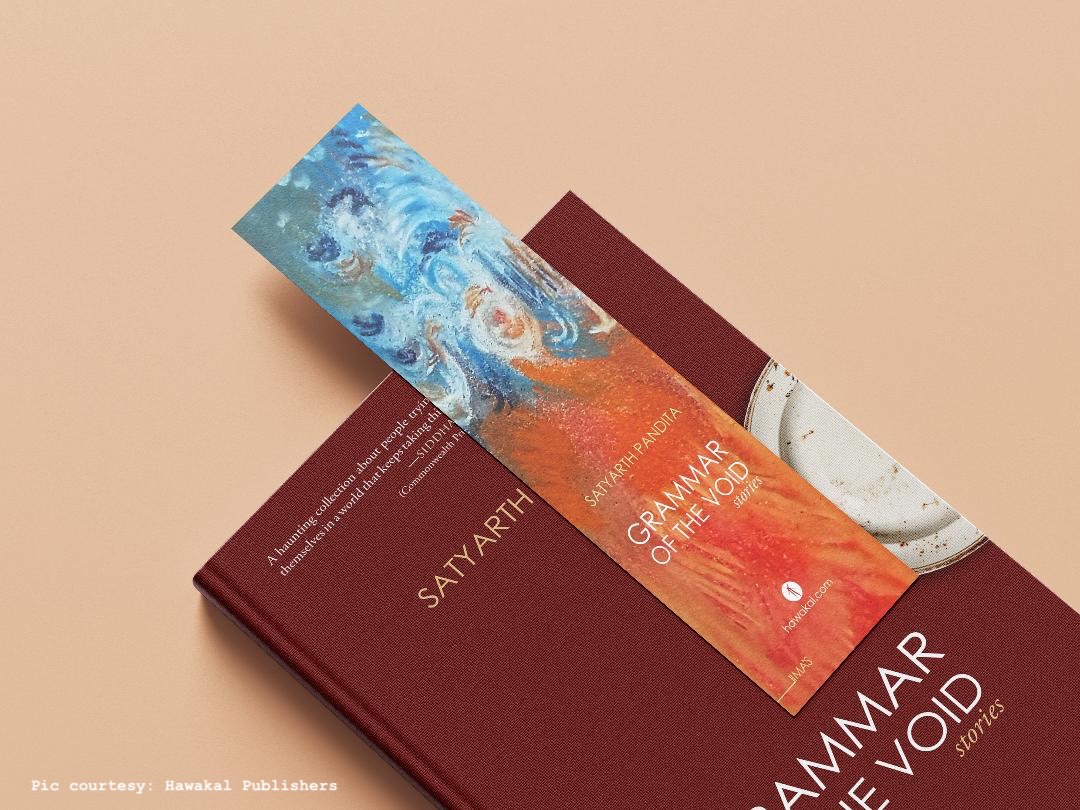
Grammar of the Void – Book Review

A debut that moves between Kashmir and the cosmos, between guilt and science fiction and somehow makes each world feel equally inhabited.

Somewhere in the author’s note, Satyarth Pandita writes that writing helps him stay sane amidst all the thoughts that run rampage in his head. I stopped and smiled, because that is exactly it. Writing is how we decide whether our thoughts need to vanish, be preserved, or explored further into something beautiful. My earliest writings were in the attic or kani as we have known it, scrawled into my Masi’s university books. She did not appreciate the vandalism. It did not stop me. I suspect Satyarth would understand.

Heading into the first story (The Birthday Gift), I half-expected a reference to Kashmir. After all, that is the backdrop to so many of our thoughts, especially for those of us who inherited Kashmir, either directly or through exile. But I was beautifully and unexpectedly transported back into a different part of my childhood instead. The soundtrack of Malgudi Days began playing in my head. The story touches on so many nuances of Indian life, things we have long accepted, but which so desperately need to change. Thought-provoking and well-written, it was a powerful opening.

There is something admirable in what Satyarth has chosen not to do. We all evolve, and so does our writing. You look back at something you wrote at a younger age and feel the urge to change the words, the phrasing, the setting. But what was written at an earlier age reflected your state of mind, your understanding of the world at that time. Updating it now would change the soul of the story. I am glad he resisted that urge.

My favourite story is The Betrayal, for all that it conveys. Satyarth takes us back to Kashmir, but not to the Chinars, the valleys, or the waterfalls. He takes us to guilt, to fear, and to what fear drives us to do to escape. Vinod’s trauma is guilt made flesh. I will say no more, for fear of giving it away, but in real life there were many Ravinders and Vinods. The story knows that, and it carries that weight honestly.

Synapse was a surprise, a clean, confident piece of science fiction that cements the author’s ability to shift between entirely different worlds and subjects. It is here that Satyarth’s scientific background reveals itself openly. The precision of thought, the comfort with neurological and biological concepts and the way he builds an imaginary world from a foundation of real science, all feel earned rather than borrowed. This is not a writer playing at science fiction. This is someone who understands the science and then asks what if. The story pivots on a moment that stopped me in my tracks. A professor explains to a writer why he alone can resist a machine that has learned to predict human behaviour:

As a writer, you hold the power of imagination, the ability to create infinite worlds, characters, and realities that defy logic. Fiction is your weapon, an unpredictable, boundless force that the machine cannot understand or counter because even you do not know how it will end.”

In a book written by a scientist-turned-storyteller, these lines feel knowingly self-aware, almost a manifesto. I will leave that discovery where it belongs, on the page, between the reader and the story.

Pirouette is, on the surface, a story about Drosophila flies with a genetic mutation that causes them to spin in endless circles until they die. But Satyarth uses this with precision to ask something far larger. Two scientists in a fog-wrapped cafeteria spend an evening trying to answer a question that the flies, spinning in their endless circles, have already answered for them. Satyarth uses the flies not as metaphor but as argument and the argument is unsettling precisely because it is never stated outright. The Emil Cioran epigraph, “A conscious fruit fly would have to confront exactly the same difficulties, the same insoluble problems as man,” turns out not to be decoration. It is a warning. Read this one slowly.

The collection closes with the story that gives the book its name. The Void earns its place as the final word. Through Avtar Kak, a widower and retired schoolteacher who schedules his nights around a phone call that rarely comes, Satyarth writes about the loneliness that polite society prefers not to name: the parent who has been left behind. And through other characters in the story, he widens that lens to an entire community. A generation of Kashmiri Pandits who left in 1990, rebuilt their lives in exile and now watch their children build lives elsewhere. The city they came to love is becoming, as one character puts it, the City of Old-Timers. It is a devastating line delivered without self-pity. That restraint is, by now, the author’s signature.

I had not read any of Satyarth’s earlier work, published or unpublished, so this was my first encounter with his words. And what an introduction it was. What strikes you as you move through the collection is that the writing evolves as you read it. It grows more complex, more layered, yet never loses its ability to engage and move you emotionally. You can feel the author’s age and life experiences quietly shaping each story, giving the later pieces a depth that feels genuinely earned. This may well be the first piece of his writing that much of the world encounters and if so, what a beginning. Well done, Satyarth. From one scientist who loves to dabble with words to another, I wish you every success in what I hope is a long and fruitful writing life.

Dr. Sheetal Raina is the founder and editor of ISBUND, an immersive platform dedicated to preserving and celebrating Kashmiri culture. Deeply connected to the heritage and traditions of Kashmir, she brings a distinctive voice to cultural discourse - blending academic insight with heartfelt commitment to her roots.

2 Comments

  • Suman K Sharma

    As his father’s friend, it has been my privilege to see Satyarth making keen attempts to hop and jump into creative writing. His first book shows he is ready to soar into vast skies. I wish him the best of luck.

  • Pratush Koul

    A very well written review that encapsulates the essence of the book. The stories make the reader dive into the sea of emotions, hitting with occasional waves of emotions- loneliness being the lighthouse. The stories are well written spreading across multiple genres and satyarth manages to do justice with all of them. I wish the writer my heartiest congratulations on his debut book and hope to see many more works from him in the future.

POST COMMENT

Your email address will not be published. Required fields are marked *