

The Places That Vanish
An abandoned island in the Persian Gulf. A car journey through Kashmir. And what it means to lose the place that made you.
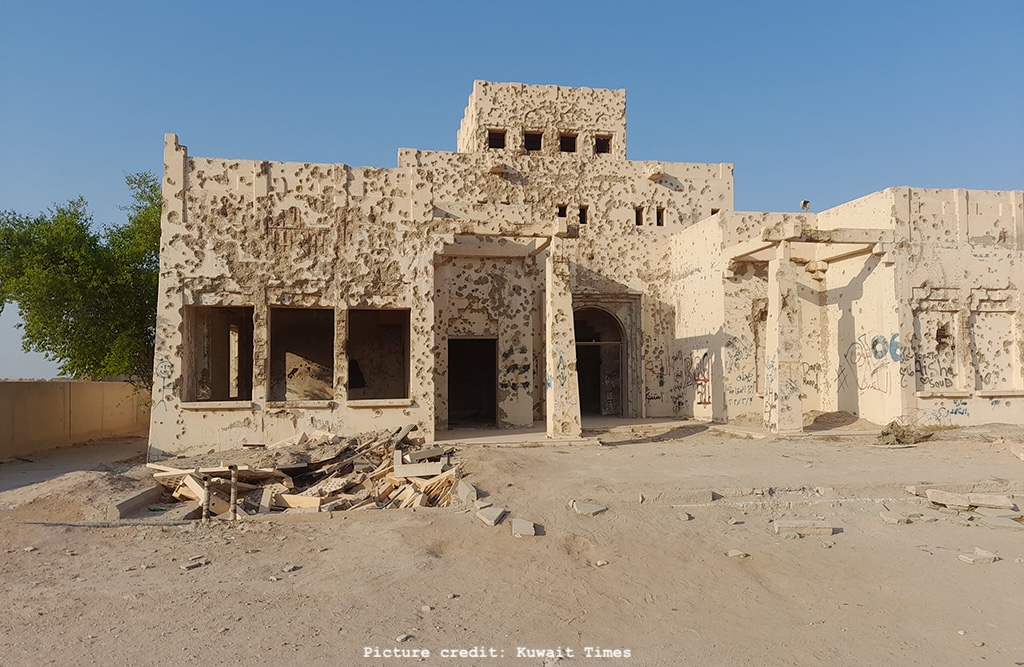
When I stepped off the boat onto Failaka’s shores in 2004, the chalets sat hollow and riddled with bullet holes. At the surface it felt as if the soldiers had used the entire town as target practice. It was hard to believe this was once a place people loved.
And yet, for more than 4,000 years, they had. Civilisation after civilisation chose this small sliver of land barely 20 kilometres off the coast of Kuwait City in the Persian Gulf, not by accident, but by design. The Dilmunites arrived around 2000 BCE, knowing it as Agarum, the sacred land of their great god Enzak, and made it a thriving hub along trade routes stretching from ancient Mesopotamia to the Indus Valley. Then came Alexander the Great, who renamed it Ikaros and found it covered in rich vegetation and wildlife held sacred by its inhabitants. Greeks built temples and fortresses here; layer upon layer, the island absorbed the weight of human ambition and devotion, holding it all beneath its sandy soil like an archive. The air still smells of salt and something older.
By the 20th century, Failaka had shed its grander ambitions and settled into something gentler, a beloved retreat. Families from mainland Kuwait would board a ferry on a Friday morning, children in tow and cross the short stretch of water for a weekend of clean beaches and island ease. Port restaurants filled with the weekend crowd, Indo-Pacific humpback dolphins moved through the warming Gulf shallows just offshore and music drifted from terraces into the evening air. It was, by most accounts, simply a good place to be.
Iraqi forces arrived in August 1990 and within days the island’s 2,000 residents were expelled to the mainland. What followed was systematic: beaches sown with landmines, monuments shelled, artefacts stolen from a Greek temple that had stood for two millennia. In February 1991, a US-led coalition forced the Iraqi garrison to surrender. The war, by then, had not merely interrupted life on Failaka. It had erased it.
I met Neda on the ferry over. She was an older woman travelling alone, unhurried, like people who have made a journey many times before. Or perhaps like people who are no longer sure why they are making it at all. We spoke a little on the crossing. She had spent every summer of her childhood on Failaka, she said, and had not been back since 1990.
I walked among the ruins with her and I listened. She spoke about the ferry ride that cost less than a dinar back then, the smell of grilled fish at the port restaurant, the way children ran straight into the sea without looking back. None of that existed here anymore. What remained were rusting tanks half-swallowed by the earth, abandoned mosques open to the sky, homes where sand had crept through the windows and settled across the floors like a slow tide. At one point she stopped outside what may have been her family’s favourite place to lodge. She recognised it only by the angle of a remaining wall and said nothing for a long time. I did not ask many questions, her wounds appeared raw, even after all that time. Some questions answer themselves.
She recognised it only by the angle of a remaining wall and said nothing for a long time.”
As Iraqi forces retreated from Kuwait, they set fire to between 605 and 732 oil wells, turning the desert into a field of black-flamed torches and smoke columns that swallowed the sun. The fires burned for almost ten months. Around five million barrels of oil were lost every day at their peak; not produced, not sold. Simply turned into thick, toxic clouds and lakes of sludge. Kuwait’s GDP halved almost overnight, and yet within two years, the same oil that had painted it as a target was financing its resurrection.
Failaka sits at the northern end of the Persian Gulf, a sea that carries more than water. Somewhere to its south, the Gulf narrows to a chokepoint so critical that roughly 20 percent of the world’s oil supply passes through it every single day. Disrupt that flow, and you don’t inconvenience an industry. You switch off the lights for a significant part of the world. The invasion that began with tanks crossing a border travelled invisibly through fuel pumps, all the way to people who never agreed to pay its price. But underneath every disrupted shipping lane is a simpler story: someone, somewhere, paying more for heat they cannot afford, or waiting longer for medicine they urgently need.
Wars and conflicts are reliably good at one thing above all else: producing people who can no longer claim what was rightfully theirs. It happens in the sudden, explosive way it happened on Failaka, and in slower, less photographed ways that accumulate just as painfully over years. The geography changes. The justifications change. The residue does not.
Some of this I understood from a distance. Some of it, I understood from the back seat of a car.
Travel north and east, into the high valleys of Kashmir and you find one of the quieter versions of this story. Older in its grief now, but no less sharp for those who carry it. The Kashmiri Pandits, a Hindu community woven into the valley for centuries, began leaving in January 1990, the same year Iraqi tanks crossed into Kuwait, driven out by violence and fear that emptied an entire community almost overnight. Scholars, farmers, families with roots deep enough to predate most of the borders drawn around them. Gone within months.
I know this not from a distance. On one winter morning in 1990, I was a young child in the back of that car, leaving Kashmir with barely any belongings and no real understanding that I was not coming back. We did not know, then, that we were not leaving for a while. We were leaving for good.
The argument about who is right rarely reaches the person standing at the edge of a courtyard that used to be theirs, looking at a doorway that now opens onto rubble or someone else’s life. The political debate continues at its own altitude. Down on the ground, what remains is simpler and harder: a person unable to get home.
Failaka. The Kashmir valley. A dozen other places whose names surface and then sink back below the news cycle. The latitudes are different, the languages different, the grievances that lit each fuse entirely different. And yet the residue is strikingly similar: a community scattered, a landscape altered beyond recognition, a generation growing up with inherited loss. You can rebuild a wall. You can, as Kuwait did, rebuild a city and an economy with remarkable speed. What you cannot rebuild, not fully, is the confidence that the place you called home will still be there when you need it. Once broken, that assurance tends to stay broken, passed down quietly through families like a habit of watchfulness, a reluctance to put down roots too deep.
The real currency of conflict is time. Time stolen from children whose schools become barracks. Time lost by parents rebuilding the same wall for the third time. Years in which a community like Failaka’s sits empty, waiting for a return that may never come. The Kashmiri Pandit family in a flat in Jammu, the Kuwaiti family on a ferry looking back at a mined beach; they are living in the long aftermath that no recovery statistic reaches.
What endures is not the rubble. It is the careful, quiet way that displaced people learn to love cautiously: to admire a place without trusting it to stay, to build without expecting to remain. That discipline, once learned, is very hard to unlearn.
The right to remain. The right to return. The quiet, unremarkable privilege of being exactly where you belong: something so ordinary that most of us have never had to name it, because no one has yet taken it away.
My father’s blue briefcase is still at the back of his cupboard. The papers inside describe a house. They do not describe a home. Not anymore.
Sheetal Raina
Dr. Sheetal Raina is the founder and editor of ISBUND, an immersive platform dedicated to preserving and celebrating Kashmiri culture. Deeply connected to the heritage and traditions of Kashmir, she brings a distinctive voice to cultural discourse - blending academic insight with heartfelt commitment to her roots.
Related Posts
Thank You for the Light (And the Wishes)
Born on India’s Republic Day, I grew up in Kashmir with curfews, bla
The Art of Science, The Science of Art: Exploring the Connection
In her thought-provoking article, Sheetal Raina recounts how her early
Building Connections: Orkut and Beyond
When strangers in a Reading living room recognised each other through
Spiced Memories, Shared Dreams: Kashmiri Pandits and the Art of Belonging
Somewhere in a small apartment in Delhi, Kishni smooths the creases on
Ties That Bind: The Unbroken Chain of Tradition
In a cosy London home, Pratiksha’s Kashmiri traditions—warm spices
How Small Habits Shape a Healthier Mind
Small, daily choices, not dramatic overhauls hold the key to a healthi


POST COMMENT